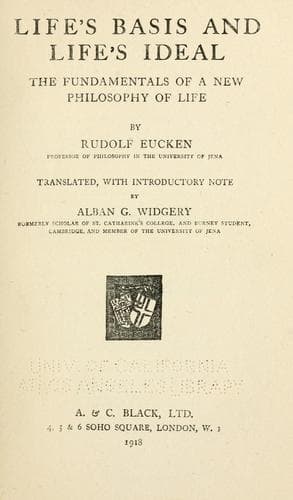
Life's Basis and Life's Ideal: The Fundamentals of a New Philosophy of LifeEucken, Rudolf
Philosophy
Life's Basis and Life's Ideal: The Fundamentals of a New Philosophy of Life
Eucken, Rudolf
Life; Ontology
The conception that we have here presented of the spiritual life and of
its relation to man also makes it for the first time possible to
understand and acknowledge the manifold and opposing elements in our
time without falling into a shallow eclecticism. Realism advances in
power, and Idealism seems to be endangered in respect not only of its
form but also of its innermost nature. Idealism is indeed in danger so
long as the spiritual life has not attained to independence in relation
to man; for, so long as the spiritual life is regarded as a production
of man the knowledge of man's relation to nature and his animal origin
must lead to a serious prostration, to a complete dissolution of
Idealism. If, on the other hand, it is established that with the
spiritual life a new order transcending the power of man makes its
appearance within him, then the recognition of human incapacity becomes
a direct witness to the independence of the spiritual life. We must,
therefore, cease to treat spiritual developments, such as religion, art,
morality, as the natural attributes of all called men. Man's natural
character simply offers tendencies and relations which can find a
spiritual character only by the revelation of a spiritual world. The
decisive point of transition is not between man and animal, but between
nature and spirit. But even where culture is supposed to be at its
highest, human existence is for the most part at the level of
nature--and is only embellished in some degree.
In Idealism a religious shaping of life is to be distinguished from an
immanent shaping of life by spiritual creation, especially in art and
science. The demand for a universal spiritual system involves the
rejection of the specific religious system as being in many ways too
narrow and open to hostile criticism; this universal system, however, as
it is presented when the spiritual life is acknowledged to be
independent, is closely related to religion. Not only is all
spirituality within us dependent upon a universal spiritual life, but
this spiritual life within us always presents itself as something
transcendent and is not coincident with our life. This religious
character must be the more clearly emphasised the greater the toil with
which the spiritual life must defend itself from a world apparently
alien and hostile. Immanent Idealism, filling life as it does through
art and science, cannot possibly be the whole and conclusive--for this
reason at least, that it has too little with which to counteract the
perplexities of spiritual and of material life, and because it
concentrates life too little within itself. But a scientific character
is indispensable to a universal spiritual culture, in order that life
may not pass in subjective feeling and presentation, and that life may
have an objective character, and be led to the clearness of a universal
consciousness. An æsthetic form and creative activity pertain also to
Public-domain text, read in full here on John Shaqi.
Reviews
Reviews
No reviews yet
Be the first to share your thoughts on this work.
Elsewhere in the archive
Join the Discussion
Join the discussion
Sign in to leave a comment or review.
Sign InorCreate an account