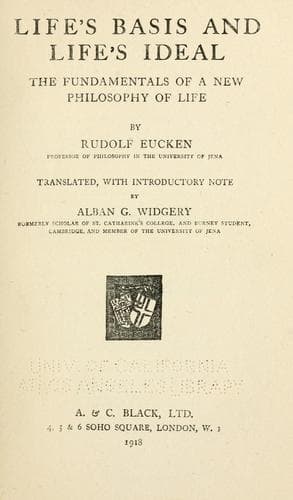
Life's Basis and Life's Ideal: The Fundamentals of a New Philosophy of LifeEucken, Rudolf
Philosophy
Life's Basis and Life's Ideal: The Fundamentals of a New Philosophy of Life
Eucken, Rudolf
Life; Ontology
Neither philosophy nor religion will convince
one who, at this point, does not recognise an elevation to a higher
power, indeed a transformation of existence. But one who recognises this
will desire such a transformation and such an elevation of culture also;
he will not come to an easy compromise with the given condition of
things and draw the greatest possible amount of pleasure from this
condition; but he will set culture an objective ideal; arouse it from
the prevailing state of indolence; fully acknowledge the antitheses of
experience, and will be provoked rather to make further exertions than
disposed to abandon himself to these antitheses. Life finds its main
problem in itself, solely in the development of an ethical character,
and attains to complete independence and a transcendence of nature only
when the spiritual takes precedence. Every culture that does not treat
the ethical task, in the widest sense, as the most important of tasks
and the one that decides all, sinks inevitably to a semblance of
culture, a half-culture, indeed a comedy. The æsthetic system, with its
transformation of life into play and pleasure, with its beautiful
language and its spiritual poverty, is such a life. To-day, therefore,
we can revive and strengthen culture only by establishing such an
ethical conviction. Only a culture of an ethical character can develop
an independent and positive spirituality; only such a culture can free
the impulse of life from being directed simply to natural
self-preservation, and in doing this not make the impulse weaker, but
stronger. In nothing have minds been more divided and in nothing will
they become more divided than with regard to the question whether, after
the perception of the inadequacy of mere nature and society, a new world
reveals itself to them, or whether this negation is the ultimate
conclusion; the former will be possible only through that which we call
ethical.
Public-domain text, read in full here on John Shaqi.
Reviews
Reviews
No reviews yet
Be the first to share your thoughts on this work.
Elsewhere in the archive
Join the Discussion
Join the discussion
Sign in to leave a comment or review.
Sign InorCreate an account