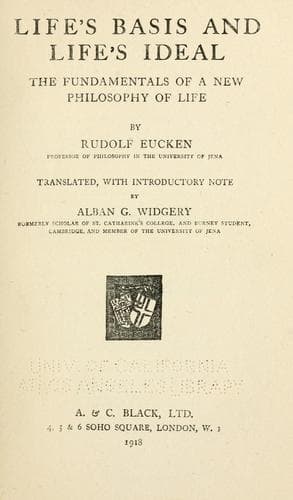
Life's Basis and Life's Ideal: The Fundamentals of a New Philosophy of LifeEucken, Rudolf
Philosophy
Life's Basis and Life's Ideal: The Fundamentals of a New Philosophy of Life
Eucken, Rudolf
Life; Ontology
The Middle Ages handed down to us a system of culture that may be
described as a hierarchy, in the widest sense of that term. The
multiplicity of life was united into a whole; but this whole was
dominated by distinctive religious and philosophic convictions, which
assigned to each individual department its place in the whole and set it
its task; these departments attained to a complete independence as
little as that system had an independence for individual forms. The
Modern Age has evolved and has realised a system of freedom in
increasing opposition to the earlier system. How this everywhere effects
an emancipation is demonstrated by our problem of the increasing
development to independence by the individual departments of life. The
state and society, science and art, find their tasks more and more
within themselves, in their own development; they engender distinctive
laws and methods of their own; they seem to be able to reach their aims
of their own capacity. Effort is directed more and more into individual
departments, and there is a feeling of complete satisfaction in this
tendency. Our life has gained immensely in comprehensiveness and breadth
by the transition to this modern system: it comes more closely into
touch with the realm of fact; it produces a greater diversity of
movement, since the different departments have their own
starting-points, enter upon distinctive paths, and direct their powers
into these paths. The attainment of independence by the individual
departments of life constitutes one of the chief gains of modern
culture, and it cannot again be given up.
But the attainment of independence by the individual departments brings
great perplexities with it, which make a definite counter-movement
necessary. At first the tendencies characteristic of the individual
departments directly contradict one another; indeed, this is inevitable,
if they are not systematised in some way. For, particular experiences of
human life are present in each department: one feels our greatness more,
another our weakness; one is moved more by the harmony of existence,
another more by the antitheses; one tends rather to exert power upon the
environment, the other to concentration in itself; from these
experiences there must originate different modes of life and different
representations of the world. In this condition of life it is impossible
for the different tendencies not to cross one another and to clash
together; and this threatens to divide our life, and to rob it of all
its inner unity. A glance at the condition of life in the present is
sufficient to convince us that such dangers are more than fancies.
Public-domain text, read in full here on John Shaqi.
Reviews
Reviews
No reviews yet
Be the first to share your thoughts on this work.
Elsewhere in the archive
Join the Discussion
Join the discussion
Sign in to leave a comment or review.
Sign InorCreate an account