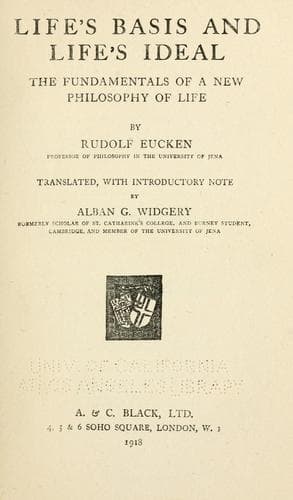
Life's Basis and Life's Ideal: The Fundamentals of a New Philosophy of LifeEucken, Rudolf
Philosophy
Life's Basis and Life's Ideal: The Fundamentals of a New Philosophy of Life
Eucken, Rudolf
Life; Ontology
This change in the direction and in the disposition of life must itself
have forced religion more or less out of the field of our attention. But
it is fraught with far more dangers to religion that the work of the
Modern Age in all its main tendencies is directed against the principles
of the life upon which the development of religion rests. Modern natural
science has dispossessed man of the central position that he formerly
attributed to himself, and has deprived nature of its soul. The modern
science of history, with its demonstration of ceaseless change in all
that is human, has undermined the faith in an absolute truth. At the
same time, with regard to the beginnings of Christianity, there is a
wide divergence between the traditional conception of faith and the new
conception obtained by historical research. The tendency of modern
culture has been to make the increasing of power, in work upon things
and in their control, the highest ideal; from the point of view of this
ideal of impersonal power, the world of pure inwardness, the home of
Christianity, has been able to appear to be simply a subjective and
subsidiary accompaniment of the life-process. He who estimates rightly
the fact that all these tendencies of modern life work together and
strengthen one another cannot fail to recognise that they force religion
from the centre of life to its circumference, and transform it from an
impregnable fact into a difficult problem; they destroy that
self-evidence of religion which previously made life secure and calm.
If, however, religion no longer springs up in the consciousness of
contemporaries from a necessity of their own life, it is not difficult
to understand that the complications of the problem are too great for
many of them; that the burden of obsolete forms over-balances the power
of their own impulse, and thus, by a sudden revolution, to reject it
seems the only way to save truth. Then religion seems to be only a
delusion that arose in a past age--a delusion similar to astrology and
alchemy; one which, in face of growing enlightenment, must ultimately be
completely dispelled.
But if the philosophic treatment understands the negation rightly, it
can only warn us against being hasty in our acceptance of it. To be
sure, quite apart from all the caprice and purpose of man, the condition
of life has become very much changed; but it was less the state of
affairs itself that permitted the changes to clash so irreconcilably
with religion than the interpretation which it received and the
exclusiveness which was attributed to it. The decision in this matter
has depended in particular upon what is called the spirit of the age,
which is often nothing more than the inclination and disposition of man;
such inclination, as history shows, may change into the direct opposite;
it does not form a sure touchstone of truth.
Public-domain text, read in full here on John Shaqi.
Reviews
Reviews
No reviews yet
Be the first to share your thoughts on this work.
Elsewhere in the archive
Join the Discussion
Join the discussion
Sign in to leave a comment or review.
Sign InorCreate an account