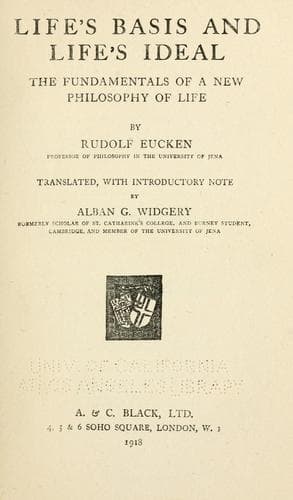
Life's Basis and Life's Ideal: The Fundamentals of a New Philosophy of LifeEucken, Rudolf
Philosophy
Life's Basis and Life's Ideal: The Fundamentals of a New Philosophy of Life
Eucken, Rudolf
Life; Ontology
In no sphere of life is there more inner division and uncertainty at the
present time than in that of religion. To one, the rejection of all
religion seems to be indispensable to the sincerity of life and to the
attainment of healthy conditions, because, as a pernicious legacy from
past ages, it oppresses our life, confuses our thought, paralyses our
power of activity, and provokes men to the greatest hatred of one
another. To another, on the contrary, religion seems to be the only
firm support in face of the needs and confusions of the age--the only
thing that inwardly unites men and elevates each individual above
himself, the only thing that reveals a depth in life and allows life to
share in the infinite and the eternal. The adherents to each of these
views show the greatest earnestness and zeal; we cannot treat the
negation lightly and dispose of it with the convenient catchword
"unbelief," if only for the reason that on the part of many this
negative attitude is due to a sincere anxiety for the truthfulness of
life. To rise above this conflict in regard to religion we must, in the
first place, estimate the points at issue impartially; and nothing else
is more called upon to do this than philosophy.
Philosophy will not make light of the prostration of religion; for a
survey of history shows that the state of life has undergone a complete
change since the epoch when religion exercised an undisputed supremacy.
At that time the world and human life received all meaning and value
from their relation to an invisible and supernatural order. The course
of the Modern Age has made the world that surrounds us ever more
significant, and since man has directed his activity upon this world,
the world of faith has been allowed to recede more and more. The
movement that led to our present position attained increasing power and
consciousness through three stages: at the height of the Renaissance the
divine was revered less in its world-transcendent sovereignty than in
its world-pervading operation; then, the Pantheism of a speculative and
æsthetic culture associated the world and God together in one reality;
finally, in the investigation of inimitable nature and the formation of
political and social relations the world of sense gives man so much to
do, fetters his power so much, and gives him at the same time such a
proud consciousness of this power, that the conception of a transcendent
world fades entirely; and an Agnosticism that rejects as superfluous and
unfruitful all reflection upon and care concerning such a world gains
ground.
Public-domain text, read in full here on John Shaqi.
Reviews
Reviews
No reviews yet
Be the first to share your thoughts on this work.
Elsewhere in the archive
Join the Discussion
Join the discussion
Sign in to leave a comment or review.
Sign InorCreate an account