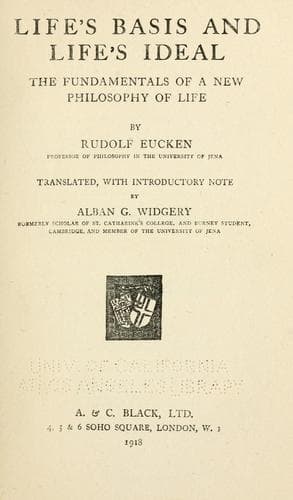
Life's Basis and Life's Ideal: The Fundamentals of a New Philosophy of LifeEucken, Rudolf
Philosophy
Life's Basis and Life's Ideal: The Fundamentals of a New Philosophy of Life
Eucken, Rudolf
Life; Ontology
But if such considerations counsel us to be cautious in regard to the
negation of religion, they do not justify an adherence to its
traditional form. The far-reaching changes of life that we are aware of
cannot possibly be explained away or their significance lessened; they
must be estimated, and brought into relation with religion. The boundary
between the eternal and the temporal, the substance and the outward form
in religion, has been made uncertain by these changes; in particular
they forbid philosophy to treat the religious problem from the point of
view of a dogmatic confession. The antithesis between Catholicism and
Protestantism is the offspring of an age that preceded the development
of modern culture, with all its deep-reaching revolutions. The main
problem of religion at the time when the antithesis made its appearance
was differently stated from the way in which we now state it. For then
it was a question whether Christianity was to be formed from society or
from personality; while to-day Christianity fights for its existence as
a whole, and must defend its fundamental truths against a time in which
activity is directed into other paths. The present antithesis cannot
possibly be regarded as ultimately identical with the former one; and it
is for this reason impossible to take up the present conflict concerning
religion under the banner of a particular dogmatic confession. Such an
ante-dating of the conflict also has the disadvantage that it prevents
the great antitheses which are involved to-day both in Catholicism and
Protestantism from being clearly displayed. Two different streams have
been present in Catholicism from its beginning: to the one, the power of
the ecclesiastical system is the main thing; while to the other, on the
contrary, the religious disposition is of supreme importance. The
influences of modern culture have increased this difference, both
directly and indirectly, and, chiefly outside of Germany, there are
signs of the beginning of a stronger movement towards a more inward
Catholicism. Protestantism carries within it an antithesis of the old
ecclesiastical form of religion, which adheres as much as possible to
the state of things in the sixteenth century, and a form transformed by
the Idealism in modern culture more into the universal, the free, the
purely human, but also not infrequently into vagueness and superficial
optimism. But so long as the bitterness of sectarian prejudice diverts
the attention of men from the chief thing, these antitheses are not
clearly expressed and energetically developed. There are serious
contradictions involved in these views of religion, and they cannot be
developed without giving rise to parties. Philosophy must strive with
all its energy to bring it about that these parties shall be formed in
relation to the present situation, and not from the point of view of a
past age; and that the conflict shall be raised to a higher level, to
Public-domain text, read in full here on John Shaqi.
Reviews
Reviews
No reviews yet
Be the first to share your thoughts on this work.
Elsewhere in the archive
Join the Discussion
Join the discussion
Sign in to leave a comment or review.
Sign InorCreate an account