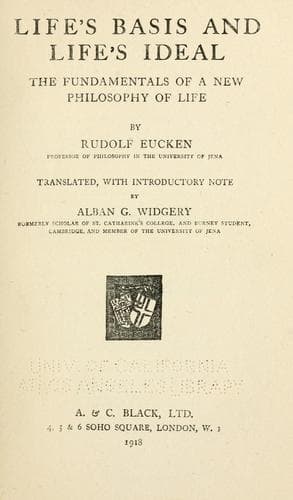
Life's Basis and Life's Ideal: The Fundamentals of a New Philosophy of LifeEucken, Rudolf
Philosophy
Life's Basis and Life's Ideal: The Fundamentals of a New Philosophy of Life
Eucken, Rudolf
Life; Ontology
truth and greatness, by bringing itself into relation with the needs of
the age.
The task of philosophy is not limited to estimating as impartially as
possible the state of things as we immediately experience it; that task
also includes a positive treatment of the religious problem. That which
is characteristic in the philosophy of life advocated in this treatise,
Noëtism, as it might be called, must also find a definite expression and
show what capacity it has, in the fulfilment of this task. In accordance
with its fundamental relation to history, which has been much discussed,
Noëtism cannot make history most important, even in religion, and cannot
read into history as much as possible of what the present demands; it
must regard any such procedure as a weakness and a half-truth. Noëtism
must insist upon religion's justifying itself and establishing its
reality before the tribunal of the spiritual life: only then can the
truth that exists in history and that which, through progressive
differentiation, promotes the cause of transcendent truth and brings it
nearer to humanity as a whole, be elucidated. We have not for a moment
lost sight of the fact that it is essential to religion to be related
not to single individuals but to all; and that religion can evolve no
power without compelling men to some kind of unity.
Now, for the treatment of the religious problem, Noëtism offers first a
position from which demands are made compatible which are otherwise
directly opposed to one another. Religion is concerned with experiences
which at one and the same time must possess a universal character,
belong to our own life, and be immediately accessible to each. The
attempt of speculative philosophy to establish religion by deduction
from the nature of the whole has the required universal character; but
it introduces religion to the soul from outside, and remains a mere
intellectual gain. The contrary attempt to base religion in the
individual soul developed an inwardness; but this attempt shows that the
soul does not know how to build up a world and to contrast it with the
subject, to present this world as something transcendent; it makes no
sure progress beyond the fluctuation and undulation of feeling. Only an
independent spiritual life, inwardly present to us, elevates us above
this division of subjective feeling and a transcendent world, and
inaugurates universal experiences in our own domain. How with the
spiritual life new realities are manifested; how a world-whole which
transcends human existence becomes evident, has already been discussed,
and it is not necessary to make any repetition here. Every
acknowledgment of an independent spiritual life is favourable to
religion in so far as this acknowledgment makes us clearly perceive the
inadequacy, the illusoriness, and the vanity of all narrowly human
conduct and occupation, its futility in matters both small and great. So
long as attention is fixed on individual matters, and so long as we may
Public-domain text, read in full here on John Shaqi.
Reviews
Reviews
No reviews yet
Be the first to share your thoughts on this work.
Elsewhere in the archive
Join the Discussion
Join the discussion
Sign in to leave a comment or review.
Sign InorCreate an account