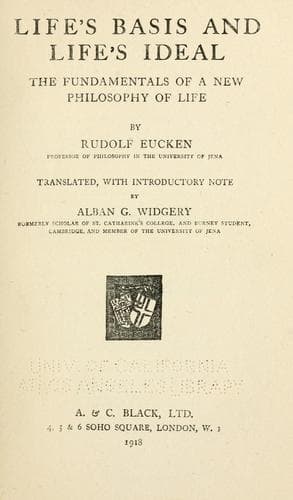
Life's Basis and Life's Ideal: The Fundamentals of a New Philosophy of LifeEucken, Rudolf
Philosophy
Life's Basis and Life's Ideal: The Fundamentals of a New Philosophy of Life
Eucken, Rudolf
Life; Ontology
From the perplexities of religion many flee to morality as to something
secure and untouched by dissension. The position of morality is, indeed,
different from that of religion. Of atheists there are many; but there
are few, if any, who deny the validity of all moral values: that
fidelity is better than deceit, love better than hate, concerning this
there is no dispute. But it is a question how far this agreement extends
and how much we may gain from it. Within the same sphere of culture at
least it is with very little difficulty that we come to agreement in
respect of individual matters of morality; if ethical societies limited
themselves to practical morality, and did not at the same time wish to
settle questions of principle, they would find scarcely any opposition.
But, as soon as we comprehend the individual matters as a whole and ask
for a foundation for the whole, problem after problem makes its
appearance, and it soon becomes clear that we can neither establish nor
distinctively form morality without a conviction concerning life as a
whole and our fundamental relation to reality. If, therefore, there is
so much uncertainty in the present concerning life as a whole and our
fundamental relation to reality, we must inevitably become doubtful and
unclear with regard to morality. In fact, the position may be described
in this way: we lack a morality which has a secure basis and a definite
character; in morality, also, after-effects of the past mingle with the
impulses of the present; and we are accustomed to conceal the poverty
of our own possessions by historical knowledge and mere learning--so
much is this the case that we are able even in a state of disgraceful
poverty to think ourselves rich. There are no less than five types of
morality which seek our adherence and the guidance of our soul: we may
suppose that in each of these there is some truth, but no single one is
able to win our acceptance entirely; each leads to a certain point, and
then we recognise a limit. We have a religious morality, in which our
volition is related to and our destiny is determined by a divine power;
but this endangers the spiritual independence of man, and has a strong
tendency to make his life too passive; besides, in this case, the
prostration of religion also weakens the power of morality and its power
to direct life. We have a morality of culture, which directs all power
towards increasing the progress of humanity, and subordinates all
subjective preference to the requirements of an objective operation and
creation; but the ceaselessly increasing differentiation of work makes
this form of morality a danger to the soul as a whole; man is in danger
of being made a mere means and instrument of a soulless process of
culture. We have a social morality, which makes the welfare of society
the chief thing, and which, by strengthening the feeling of solidarity,
produces humane efforts in abundance, but is unable to include life as a
Public-domain text, read in full here on John Shaqi.
Reviews
Reviews
No reviews yet
Be the first to share your thoughts on this work.
Elsewhere in the archive
Join the Discussion
Join the discussion
Sign in to leave a comment or review.
Sign InorCreate an account