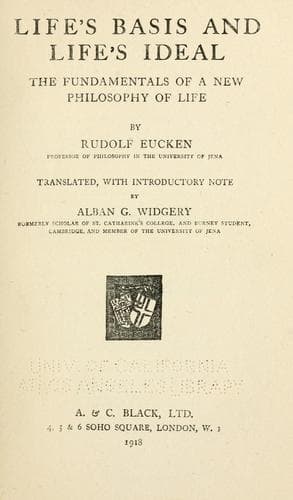
Life's Basis and Life's Ideal: The Fundamentals of a New Philosophy of LifeEucken, Rudolf
Philosophy
Life's Basis and Life's Ideal: The Fundamentals of a New Philosophy of Life
Eucken, Rudolf
Life; Ontology
whole; in this form of morality there is a great danger of
overestimating external conditions of life, and of levelling and
weakening life. Certain great thinkers have advocated a morality of pure
reason, which elevates man above the sphere of the useful and the
pleasant; and gives to him an inner independence; but with all its
greatness this morality is too formal and too abstract for us; and,
besides, we lack to-day the certainty of an invisible world, which alone
can give a secure foundation to this type of morality. Lastly, we have
an individualistic morality, a morality of beautiful souls, which
regards the complete development of one's own particular nature, the
harmonious cultivation of the whole range of one's powers, as the aim
of conduct, but which not only necessitates individuals who are far
greater and far more characteristic in nature than we find in experience
in general, but also has little power to arouse us to effort, and, if
accepted exclusively, soon tends to degenerate into a refined
self-enjoyment and vain self-reflection.
The presence of all these tendencies and motives in morality subjects us
to-day to an abundance of ethical stimuli; but it does not give us an
ethic. At the most it conceals the fact that the multiplicity of
activities do not form for us a universal task, which could counteract
the separation into individuals, parties, particular departments, and
give us the consciousness of serving in our work aims that transcend the
well-being and preference of mere man. We are in need of a morality that
proceeds from our own life; and in this we need much more than we are
conscious of needing. For we have no universal aim that we might take up
in our disposition, and by which we might test all individual
activities; and so life must become disunified and inwardly alien; we
lose all spiritual relation to the world. The world surrounds us in the
first place as a dark and immovable fate; we do not make ourselves
masters of this fate, just because we give ourselves too much to do with
things. Rather, to accomplish this, we must transform reality from its
very foundation by our own activity and decision; we must wage war
against obscurity and irrationality, and this conflict must tend to
divide our whole existence into friend and enemy, good and evil, but
along with this first give to life complete activity, and lead it to
world-embracing greatness. Only in this way does man, from being simply
a spectator, become a co-operator in the building up of the world; only
thus does that which occurs within him become in the fullest sense his
own. Everything which obscures the ethical character of human life
involves, therefore, a loss in greatness and dignity; a degeneration to
a state of servitude, to being a mere part of an alien whole. Particular
parties may be in agreement with and find satisfaction in this
condition; humanity as a whole will not rest content with it. As
Public-domain text, read in full here on John Shaqi.
Reviews
Reviews
No reviews yet
Be the first to share your thoughts on this work.
Elsewhere in the archive
Join the Discussion
Join the discussion
Sign in to leave a comment or review.
Sign InorCreate an account