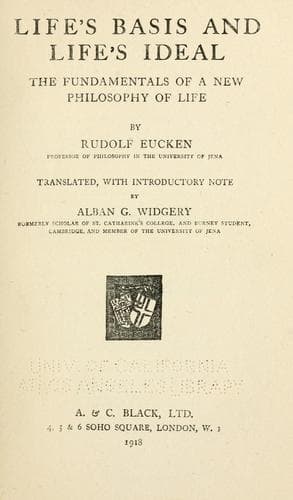
Life's Basis and Life's Ideal: The Fundamentals of a New Philosophy of LifeEucken, Rudolf
Philosophy
Life's Basis and Life's Ideal: The Fundamentals of a New Philosophy of Life
Eucken, Rudolf
Life; Ontology
The morality of the spiritual life, as we advocate it, will have
distinctive features in comparison with other conceptions of morality;
of these we can mention but a few here. The acknowledgment of an
independent spiritual life makes life as a whole a task, since it
requires that as a whole it should be changed into a state of
self-determining activity; that everything must be aroused and set in
motion. Thus the morality of the spiritual life is constructive and
progressive, and not simply regulative in character; it is not its
purpose simply to place life under regulations and to let activity wait
until there is an opportunity to fulfil them; but, calling forth all
our powers, morality must work and create, arouse and prepare the
opportunities, so that in everything the realm of the spirit may be
increased within the province of humanity. Like the spiritual life
itself, the morality proceeding from it must be of a transcendent
nature. To-day or to-morrow may not be considered beyond good and evil;
morality may not sink to being a mere means of realising the wishes of
the time. If, however, morality transcends time, and is able to separate
the transitory and the eternal in time, then, within its task, it may
very well acknowledge distinctive situations and problems, and present
different sides; indeed, only by a close relation with the time and by
penetrating deeply into the experiences of the time will morality
acquire the necessary proximity and impressiveness. To this extent,
therefore, we also insist upon a modern morality, however decidedly we
reject that which to-day is called "modern" morality, and which for the
most part is no more than a surrender of morality to the wishes and
moods of the individual.
Public-domain text, read in full here on John Shaqi.
Reviews
Reviews
No reviews yet
Be the first to share your thoughts on this work.
Elsewhere in the archive
Join the Discussion
Join the discussion
Sign in to leave a comment or review.
Sign InorCreate an account