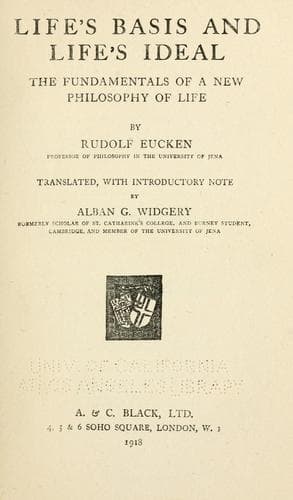
Life's Basis and Life's Ideal: The Fundamentals of a New Philosophy of LifeEucken, Rudolf
Philosophy
Life's Basis and Life's Ideal: The Fundamentals of a New Philosophy of Life
Eucken, Rudolf
Life; Ontology
Wherever it is acknowledged that the spiritual life involves a turning
of reality to complete independence and spontaneity, morality must take
a significant, indeed the central, position. For it is clear that only
the taking up in our own activity and conviction, only complete
appropriation, can bring life to the highest degree of perfection.
Morality does not find in existence a life-content which it must convey
to the individual subject, but is itself within the life-process; a
complete self-consciousness of the spiritual life is attained first in
morality, and morality must develop the content of that life. It is not
that man in morality turns toward the spiritual life, but that the
spiritual life elevates itself in the whole of its nature; all human
morality must have its basis in a morality of the spiritual life.
With such a basis in the innermost nature, morality must concern the
whole multiplicity of life; it can include and estimate the most diverse
relations and experiences of our existence. But whatever is thus brought
under the sway of the morality of the spiritual life must undergo an
essential change, and must be elevated above the nature of that which is
not taken up in this manner. By an ethical formation and development of
art and science we do not mean that the individual should be loyal and
straightforward in their pursuit, and should follow honest aims; this
conception would be much too narrow. But it is that we should take
possession of and treat as our own life and being that which otherwise
remains outside as something half alien to us; that the work should
acquire the power and fervour of self-preservation; and that in this
unification the necessity of the object becomes a definite demand of our
life, and the gain of the object an advance of our life. Only such a
life which transcends the antithesis of subject and object gives to the
object a soul, and freedom a content.
The experience of history also makes it clearly evident to us that the
spiritual life first acquires a secure position and an indisputable
supremacy over nature by its acknowledgment and appropriation in
self-determining activity. For history shows that wherever morality is
not central, the spiritual life, even in the midst of the most
magnificent results in external matters, languishes inwardly and loses
its hold. With individuals also the final decision concerning the
problems of the world and of life always depends upon whether they do or
do not recognise that man has an inner moral task in his nature as a
whole. If this is acknowledged, then--and this just in oppositions and
conflicts--a realm of inwardness is assured us which all apparently
contrary experiences of the external world cannot expel from its central
position; but if there is no such acknowledgment, the triumph of these
experiences and the collapse of the spiritual life cannot be avoided.
Public-domain text, read in full here on John Shaqi.
Reviews
Reviews
No reviews yet
Be the first to share your thoughts on this work.
Elsewhere in the archive
Join the Discussion
Join the discussion
Sign in to leave a comment or review.
Sign InorCreate an account