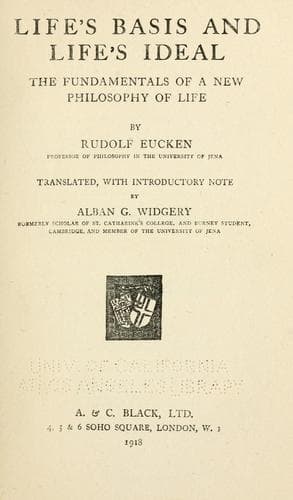
Life's Basis and Life's Ideal: The Fundamentals of a New Philosophy of LifeEucken, Rudolf
Philosophy
Life's Basis and Life's Ideal: The Fundamentals of a New Philosophy of Life
Eucken, Rudolf
Life; Ontology
become dogmatically pursued in paths that have become fixed. Finally,
the problem of the relation of thought to life is the source of much
perplexity: we Germans, for example, have a strong tendency to take mere
knowledge for inner appropriation of the object, and instead of
spiritual substance to offer an abundance of scholarship. This, however,
is not a defect in science itself, but an error on the part of man, who
has no life of his own with which to meet the onflow of impressions from
the environment; and so our estimate of science and our acknowledgment
of its magnificent achievement cannot be affected by this charge.
Philosophy is in quite a different position: its present state cannot
satisfy anyone who seeks rather for a universal science than for an
academic discipline. For our philosophical efforts lack a common aim and
close relation with the innermost need of the time; they do not even
show any definite and energetic attempt to overcome the confusion from
which our world of thought suffers. A great stream of philosophic effort
came to an end with the speculative philosophy of the first decade of
the nineteenth century. After a temporary ebb of this philosophic
effort, we now wish to take up the work again with fresh power, but we
have not yet acquired inner independence; and therefore, in sifting and
collecting, we are unable to direct the age to definite aims, or
radically expel the inconsistencies into which an indefinite relation to
the past has led the present.
Public-domain text, read in full here on John Shaqi.
Reviews
Reviews
No reviews yet
Be the first to share your thoughts on this work.
Elsewhere in the archive
Join the Discussion
Join the discussion
Sign in to leave a comment or review.
Sign InorCreate an account