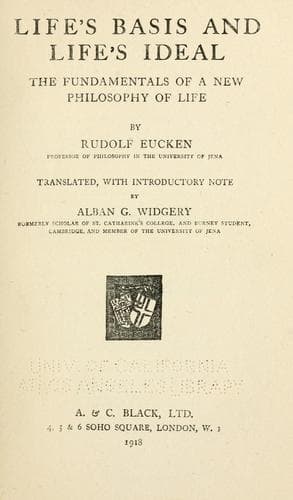
Life's Basis and Life's Ideal: The Fundamentals of a New Philosophy of LifeEucken, Rudolf
Philosophy
Life's Basis and Life's Ideal: The Fundamentals of a New Philosophy of Life
Eucken, Rudolf
Life; Ontology
There are three main streams of thought which come to us from the past,
and we can neither completely take them up nor withdraw ourselves from
them: the Enlightenment, with its philosophic summit in Descartes; the
critical philosophy of Kant; and speculative philosophy, with its
consummation in Hegel. It has been thought that the Enlightenment, with
its starting out from the subject, its unadorned intellectualism, its
formal ratiocination, its rejection of everything that is not
comprehended in clear and distinct ideas, was transcended at the height
of German classical literature, because at that time a life rich in
content was set in contrast with it. But, as a fact, no adequate
settlement with the Enlightenment has been arrived at; the supposed
transcendence is not final, because the elements of truth in the
Enlightenment, especially its turning from history to the immediacy and
independence of spiritual life, were not properly acknowledged. But
to-day it is less the elements of truth of the Enlightenment that are a
force than that which is trivial and narrowly human in it--the
ratiocination of the subject which, the more empty it is, the more it
feels itself to be the measure of all things, and, rejoicing in
negation, applies the results of the natural sciences in an attempt to
bring about the greatest possible suppression of all spiritual
relations. In this form the Enlightenment gains acceptance by the
masses, which formerly had seemed inaccessible to it; and thus it
becomes an instrument by which life is dissipated and made shallow.
From its position of research, philosophy looks down upon this tendency
with contempt; but it produces no movement that is able to take up the
struggle with this tendency to shallowness, and pass through the
struggle victoriously. Kant is often lauded as the spiritual guide of
our time; and it is overlooked how much that was certain for him has
become doubtful; how many new facts, new problems, new prospects, which
cannot be lost to the world of thought we have received from the
nineteenth century with its historico-social culture and its
overwhelming widening of the horizon. Kant's critique of the reason is
based on a conception of science; on a faith in the possibility of a
knowledge of truth; on a conviction of a spiritual organisation of man,
which are rather in contradiction than in harmony with the main
tendencies of the present. His absolute ethic, the pillar of his
constructive thought, is incompatible with the empirical and social
treatment of morality to which the present does homage. But at the same
time we cannot free ourselves from the influence of Kant. For we cannot
refute his critique of the reason, breaking up, as it does, the old
representation and conception of truth; and, without his ethic, our
ethic would lose the appearance of truth and greatness. In the judgment
of the present, Hegel experiences a treatment that is just the opposite
Public-domain text, read in full here on John Shaqi.
Reviews
Reviews
No reviews yet
Be the first to share your thoughts on this work.
Elsewhere in the archive
Join the Discussion
Join the discussion
Sign in to leave a comment or review.
Sign InorCreate an account