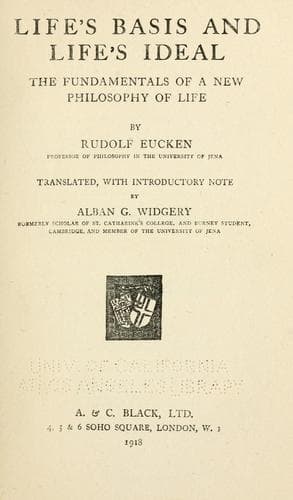
Life's Basis and Life's Ideal: The Fundamentals of a New Philosophy of LifeEucken, Rudolf
Philosophy
Life's Basis and Life's Ideal: The Fundamentals of a New Philosophy of Life
Eucken, Rudolf
Life; Ontology
of that which Kant receives: if in reference to the latter we do not
notice what divides us, so in reference to the former we fail to
recognise what joins us. For if Hegel's exaggeration of the power of the
human spirit and his identification of spirit and thought appear alien
to us, yet his idea of evolution, which embraces all multiplicity, and
represents all realities and conceptions as in a state of flux; his
elevation of spiritual factors to the form of independent powers which
develop and establish their own necessities undeterred by the preference
of man; his emphasis on the fact of the power of contradiction and
opposition in history--all this, often in spite of our own conceptions,
exerts an enormous influence over us; and we cannot shake it off
without surrendering a considerable portion of our spiritual possession.
These tendencies all whirl confusedly together and draw us now in one
direction, now in another; we can get beyond the state of decadence only
when we have succeeded in giving to the world of thought an independent
character, which corresponds with the spiritual condition of the
present, and which can do justice to the old as well as the new
experiences. After the whole course of our investigation, only a brief
account is necessary to indicate the directions the system of life here
advocated points out to reach this; a fuller treatment would make a
particular theory of knowledge necessary. We must bring into prominence
three of the chief points.
(1) Only the life-process can be the starting-point of philosophy, not
some kind of being more ultimate than this process, whether we conceive
of such being as an external world or as a subject existing independent
of the world: the ideas of "world" and "subject," as also that of
"being," can be evolved and made clear only within the life-process; at
the same time, they remain in a state of flux, and never are so directly
opposed to one another as modern thought has represented them as being.
Philosophy, with this starting-point, would, however, attain an
independence in relation to the special sciences only if it were
possible within the life-process to form a unity and a distinctive
synthesis, which should deepen our view of reality and set it as a whole
in a new light. (2) Such a synthesis must transcend the state of change
of all the relations and caprice of men; this is possible only by the
revelation and appropriation of an independent spiritual life withdrawn
from the life of sense. Without such a spiritual life there is no
release from the chaos of subjective experiences and opinions; only from
the position of the spiritual life is it possible for a spiritual
occurrence to be revealed in the province of man, so that we do not need
to infer from man to the world, but that within him a universal life can
be immediately experienced. (3) As, on the one hand, the spiritual life
is an indispensable presupposition, so on the other it is an infinite
Public-domain text, read in full here on John Shaqi.
Reviews
Reviews
No reviews yet
Be the first to share your thoughts on this work.
Elsewhere in the archive
Join the Discussion
Join the discussion
Sign in to leave a comment or review.
Sign InorCreate an account