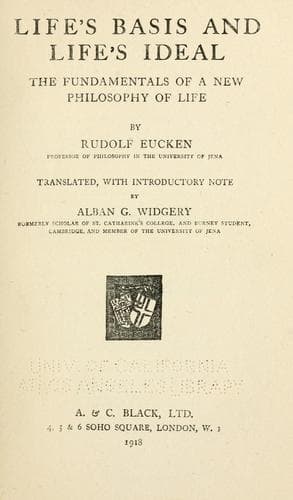
Life's Basis and Life's Ideal: The Fundamentals of a New Philosophy of LifeEucken, Rudolf
Philosophy
Life's Basis and Life's Ideal: The Fundamentals of a New Philosophy of Life
Eucken, Rudolf
Life; Ontology
This acknowledgment of personal and of historical life by philosophy
makes it intelligible why philosophy manifests so much diversity and
opposition, and why on the surface it shows so little unity. Where the
conviction of an independent spiritual life rules, the faith in a unity
of truth can be shaken by this fact just as little as the courage to
creative activity can be paralysed. The basing of thought upon the
spiritual life also has the advantage that the main types of thought can
be derived from the different positions which may be taken up towards
the spiritual life, and thus a limit may be set to the otherwise
indefinite abundance. From this point of view there are for us five
chief types of thought and world-conception. Minds first divide on the
question whether we can unify life at all, and at the same time whether
we may venture to make an assertion concerning reality as a whole. He
who rejects this as impossible and readily surrenders himself to the
conflict of immediate impressions might be called an indifferentist. If,
however, a striving towards unity is admitted, then the question whether
a spiritual life with a reality and values of its own in contrast with
nature may be acknowledged or not becomes the point of decision, and the
basis of division into opposing camps. He who gives a negative answer to
the question, and regards nature as the whole of reality, becomes an
advocate of Naturalism. He, however, who answers in the affirmative, and
may be called an idealist, is immediately confronted with a new problem.
He cannot acknowledge the spiritual life without at the same time giving
it the supremacy; but now the doubt arises whether this supremacy may be
easily and peacefully established, or whether it meets with strong
opposition. When the existence of these oppositions is denied, or they
are regarded as being easy to overcome, there grows up an optimistic,
contemplative form of Idealism, which to the holders of other forms
inevitably seems abstract and shallow. If, on the contrary, the
oppositions are fully acknowledged, the final division originates with
the question whether finally we are to submit to the state of stagnation
brought about by these oppositions, or whether by some kind of
reinforcement of the counteraction to this state of stagnation life may
once more be set in progress: the former gives rise to Scepticism and
Pessimism, the latter to Activism, as it has been discussed by us in an
earlier section. It is easy to see what distinctive lines of conflict
and what kinds of conflict must arise between the indifferentist, the
naturalistic thinker, the optimist, the sceptic, and the activist.
However, we cannot allow this to detain us; it must, nevertheless, be
pointed out here, that in philosophy the possibilities are not yet
exhausted, and that to avail ourselves of these possibilities nothing is
more necessary than a close relation of its work with the life-process,
Public-domain text, read in full here on John Shaqi.
Reviews
Reviews
No reviews yet
Be the first to share your thoughts on this work.
Elsewhere in the archive
Join the Discussion
Join the discussion
Sign in to leave a comment or review.
Sign InorCreate an account