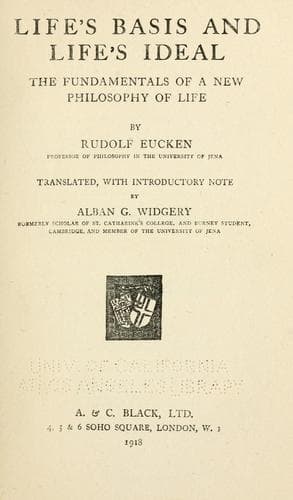
Life's Basis and Life's Ideal: The Fundamentals of a New Philosophy of LifeEucken, Rudolf
Philosophy
Life's Basis and Life's Ideal: The Fundamentals of a New Philosophy of Life
Eucken, Rudolf
Life; Ontology
and a firmer grounding in the independent spiritual life.
(c) ART AND LITERATURE
Nowhere does modern life throb more violently and more strongly than in
art and literature. That which in this department has a claim to
permanence acquires especial power from the fact that this department
had to establish itself anew in opposition to an attempt to curtail it.
For who could deny that a culture of work and of utility had a tendency
to reduce artistic literary creation to the position of an accompaniment
and a fringe of another kind of life, to a diversion for idle hours? The
more we feel the limitations of the life of work and utility the more do
art and literature become independent tasks. From art and literature we
expect more lightness, more agility, and more joy in life; they should
conduct life from too great an attention to externals to
self-consciousness, and in this way give life a soul. They should
strengthen individuality in opposition to the levelling tendency of the
culture of the masses, wrest simple fundamentals from chaotic confusion
of life, and aid the time in reaching a comprehensive vital-feeling and
a synthesis transcending its inconsistencies. In opposition to that
which oppresses us and degrades us to instruments of a meaningless
machinery, we desire some kind of province where life rests in itself
and purposes nothing else but itself; where it springs up with complete
spontaneity; and where it can express itself with complete freedom, and
in this expression find its highest joy.
From such a longing a new art that permeates our life has arisen. Art
must seek new means of expression for the new situation; it cannot serve
the development of a new life-content without bringing about liberation
from all conventional statutes; it cannot prevent a threatened tendency
of life to become stagnant without desiring a fully free place for the
subject, and for the development of his individuality. He who sees
chiefly the dangers in everything forgets that nothing new and great can
arise without bringing dangers with it.
From the point of view of the system that we champion, we can quite well
understand the significance of the æsthetic movement of the present,
acknowledge the deliverance of life which it has accomplished, and in
general we can go a good distance with it. But there comes a point where
the courses diverge; not because we think less of the capacity of art,
but we believe that we think more highly of its task. This deliverance
from the culture of work, this turning to individuality, promises an
essential elevation of life only if a new kind of being, a new world, is
able to break forth in the soul that depends upon itself; if the
individual in his conflicts aids the development of the infinite life;
if, through all transformations and prostrations, man wins an inner
relation to the whole and to things, and by this grows beyond the
narrowly human.
Public-domain text, read in full here on John Shaqi.
Reviews
Reviews
No reviews yet
Be the first to share your thoughts on this work.
Elsewhere in the archive
Join the Discussion
Join the discussion
Sign in to leave a comment or review.
Sign InorCreate an account