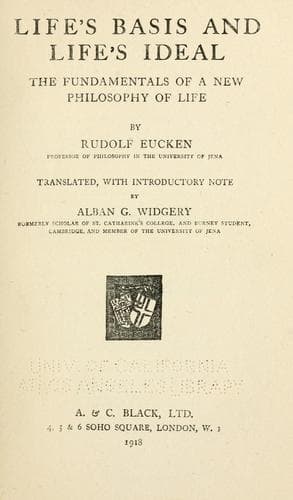
Life's Basis and Life's Ideal: The Fundamentals of a New Philosophy of LifeEucken, Rudolf
Philosophy
Life's Basis and Life's Ideal: The Fundamentals of a New Philosophy of Life
Eucken, Rudolf
Life; Ontology
In contrast to the epoch of the Enlightenment, the nineteenth century
brought about a transition from the individual to society: social life
has developed in numerous branches, has disclosed a superabundance of
new facts, and has set us new tasks. But this development has also
brought much perplexity with it. It becomes evident in this development
also, that each spiritual movement that attains power experiences in its
further course limitations, and is degraded by its contact with human
conditions. Along with the social movement there has been the
often-discussed change by which life from being centred in an invisible
world becomes occupied with the visible one, and by which all
departments of life are given a naturalistic, realistic character and
tendency. There has been no lack of opposition to the movement to make
society the first consideration; the opposition has gone even so far as
to dispute the right of the whole. Further, the earlier and the later
conception of society, the idealistic and the realistic, are often
confused; and from this confusion contradictions arise that not only
confuse our ideas but also degrade our life. There is a danger that a
zealous and excited occupation with nothing but individual tasks may
take our attention from the whole, and that the problems which the inner
condition of man involves may not obtain due consideration.
This turning to society is most manifest in the powerful advance of the
state. In this, an inner longing for a more social life, as Hegel
especially philosophically advocated it; and actual changes of
conditions operated together, and strengthened one another. The more
definite manifestation of individuality on the part of nations and the
sharper division between them; the active interest of wider circles in
political problems; the mechanical organisation of work, with its more
exact differentiation and its more rigid organisation of forces; but
primarily the longing, which grows out of the ceaselessly increasing
economical and social perplexities, for a power superior to the parties
in dispute and acting as arbitrator--all these have immeasurably
increased the power of the state in different degrees among different
peoples, but in general through the whole civilised world.
Public-domain text, read in full here on John Shaqi.
Reviews
Reviews
No reviews yet
Be the first to share your thoughts on this work.
Elsewhere in the archive
Join the Discussion
Join the discussion
Sign in to leave a comment or review.
Sign InorCreate an account