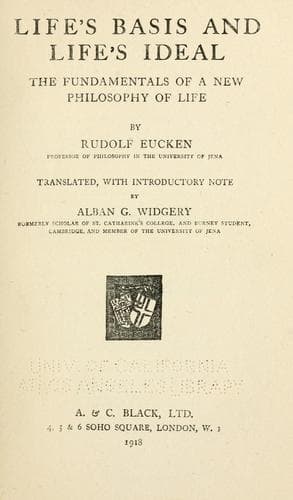
Life's Basis and Life's Ideal: The Fundamentals of a New Philosophy of LifeEucken, Rudolf
Philosophy
Life's Basis and Life's Ideal: The Fundamentals of a New Philosophy of Life
Eucken, Rudolf
Life; Ontology
The freedom of the individual, therefore, cannot but suffer from
manifold limitations; there arises a danger that the individual may
gradually lose all initiative, and expect all stimulation from the
state. The spontaneity and the wealth of life suffer from the tendency
to increase the power of the state, and a bureaucracy which delights in
correct forms, but which spiritually is entirely unproductive, indeed
even indifferent, appropriates more and more to itself. The substance of
the spiritual life is also threatened by the fact that the omnipotent
state is inclined to treat that life, with all its branches, as a mere
means in the attainment of its own particular aims; to look upon science
and art, and chiefly religion and education, especially with regard to
that which they achieve for the aims of the state, and to shape them as
much as possible in accordance with these aims. There is also a strong
tendency to follow the same course to accomplish the ends of the
contemporary form of government. An independent and genuine spiritual
life can hardly offer too great an opposition to such a perversion,
with its deification of human forms. But the matter is by no means
simple; for not the will of single individuals and parties, but the
whole tendency of modern life has given this power to the state; indeed,
on the economic side the state will soon experience a further increase
of power. The more the guidance on this side belongs to the state, the
more necessary is a free movement of spiritual culture in opposition to
it; the more urgent is the demand that the amalgamation of church and
state should be discontinued--an amalgamation which, by the growing
disputes that arise from it, forces religion into an undignified
position; the more definitely is a greater independence to be desired
for school organisation in all its branches. The Germans especially have
much to do in this matter; and there is much at stake. For, with the
limitations of our spatial extension, we can be a permanent determining
factor in world-culture only by giving our culture the greatest
intensity; but this requires a calling forth of the complete power and
of the spontaneity of individuals. Ultimately, in this matter also, the
chief thing proves to be the taking up again of central problems and the
realisation of human being in its innermost depths as an unconditional
end in itself and the bearer of an infinite life. No conception can
guard us from sinking to the position of puppets of the soulless
mechanism of the state, if we do not find the power to give soul to our
life and to maintain it against all attempted limitation.
Public-domain text, read in full here on John Shaqi.
Reviews
Reviews
No reviews yet
Be the first to share your thoughts on this work.
Elsewhere in the archive
Join the Discussion
Join the discussion
Sign in to leave a comment or review.
Sign InorCreate an account