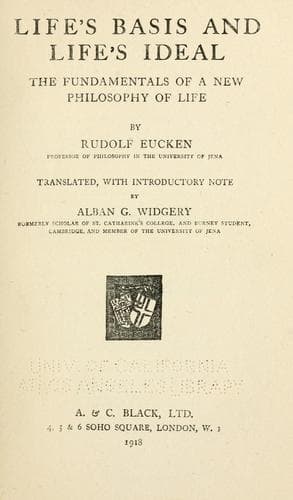
Life's Basis and Life's Ideal: The Fundamentals of a New Philosophy of LifeEucken, Rudolf
Philosophy
Life's Basis and Life's Ideal: The Fundamentals of a New Philosophy of Life
Eucken, Rudolf
Life; Ontology
The longing for more freedom and independence has therefore an
indisputable validity. But this acknowledgment may easily lead to new
complications by freedom and independence being conceived in a manner
much too external, and also by a really questionable association of
these ideas with the problem of equality. The conviction of the modern
man concerning the world on the one hand, and the demands of life on the
other, are often in direct contradiction with regard to the conception
of equality. We become aware of our limitation on all sides: we are
represented simply as a product of heredity and environment: all
possibility of making a decision for ourselves is rejected as a
delusion. If thus we are deprived of all independence and all
spontaneity of life, then even in social life we shall become mere
bearers of a _rôle_ imposed upon us by a dark fate. One does not see how
freedom could retain a value, arouse enthusiasm, and lead to sacrifice
in such a case. If the whole is a soulless mechanism, in which only the
excess of existent power is the cause of decisions, then we ourselves
cannot be exceptions.
Other complications have their origin in the democratic tendency which
permeates not only our political endeavour but also our whole life of
culture. How far-reaching a change, indeed how complete a revolution,
has been accomplished by this tendency in opposition to a condition of
things which has stood for hundreds or rather thousands of years, is but
seldom fully appreciated. In the earlier form of social life spiritual
work was the chief matter only of a limited and exclusive circle; to the
people as a whole it was only secondary, and the benefit that they
received from it was often of the most meagre character. Even the
Reformation left this aristocratic form of life as it was; for as
certainly as it made the care for every individual member of the church
more urgent, that care was bestowed from above in an authoritative
manner. The earlier Enlightenment, as it was represented, for example,
by Bayle, was of the conviction that the deliverance from delusion and
superstition would always be limited to a small circle of those standing
spiritually high, and would never reach the masses. We know how this has
changed; how the masses are determined to form a mere dependent body of
the so-called higher classes no longer, but to take the problem of life
independently into their own hands, and how they obtain their
representation of the world and the task of their life from that which
is more immediately present to them and directly concerns their welfare;
and how in this way they are inclined to look upon themselves as the
whole of humanity. We have already referred to the danger that culture
as a whole will thus be made shallow--a danger that arises from the fact
that here the decision is made by those who scarcely participate in the
work of history, and who depend almost entirely upon the immediate
impression.
Public-domain text, read in full here on John Shaqi.
Reviews
Reviews
No reviews yet
Be the first to share your thoughts on this work.
Elsewhere in the archive
Join the Discussion
Join the discussion
Sign in to leave a comment or review.
Sign InorCreate an account