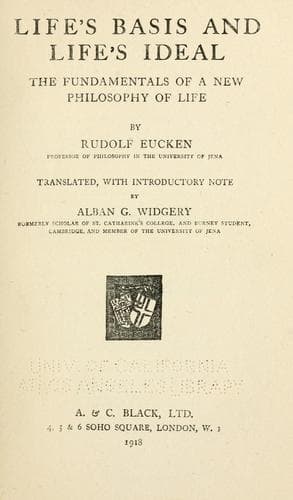
Life's Basis and Life's Ideal: The Fundamentals of a New Philosophy of LifeEucken, Rudolf
Philosophy
Life's Basis and Life's Ideal: The Fundamentals of a New Philosophy of Life
Eucken, Rudolf
Life; Ontology
The independence of the individual and the spontaneity of the spiritual
life are endangered not only by the mechanism of a bureaucracy
indifferent to spiritual values but also none the less by the movements
of the masses, which in modern life in particular surround and browbeat
the individual. The man of the present day often believes that he has
gained freedom when in reality he has only changed the nature of his
dependence. What makes the movements of the masses, with their so-called
public opinion, so irksome is the falsehood that is generally contained
in this opinion, which is presented as proceeding from the experience
and decision of a great majority, and therefore as having a definite
presupposition of truth. The fact, as a rule, is that a few venture an
assertion and urge it upon the others with unobserved compulsion, since
they proclaim as already existent the agreement that they are only
seeking. Of course sometimes there is much more in public opinion; it
may be the expression of a spiritual necessity which subjects to itself
the dispositions of men. Whether public opinion is to be an interpreter
of truth or a mere product of man remains to be decided; and this
decision can rest only with the individual. He will be equal to making
this decision if he possesses a spiritual experience, and has in this a
touchstone by which to distinguish the genuine from the false.
Philosophy can maintain the rights of the individual only so far as he
is rooted in spiritual relationships and derives power from them; it
must absolutely oppose all glorification of the natural, spiritually
destitute individual. We find such a glorification to-day more
especially in that which, with particular emphasis, is called "modern"
morality, but which in fact threatens rather to be a complete negation
of morality; even though this negation is against the intentions of its
advocates, mostly women, who display great enthusiasm for this "modern"
morality. It seems as though life is limited and degraded because
society, particularly in the matter of the sexual life, prescribes rigid
statutes which, if they were not irrational at the beginning, have
nevertheless become irrational, and tend to brand the right as wrong and
the wrong as right. The shaking off of these restrictions and of the
pressure of society in general seems to promise a form of life
incomparably more powerful, sincere, and individual: this life is also
to offer more beauty, for to-day generally the idea of beauty is
emphasised with great partiality where life has no clear ideas and no
significant content.
Public-domain text, read in full here on John Shaqi.
Reviews
Reviews
No reviews yet
Be the first to share your thoughts on this work.
Elsewhere in the archive
Join the Discussion
Join the discussion
Sign in to leave a comment or review.
Sign InorCreate an account