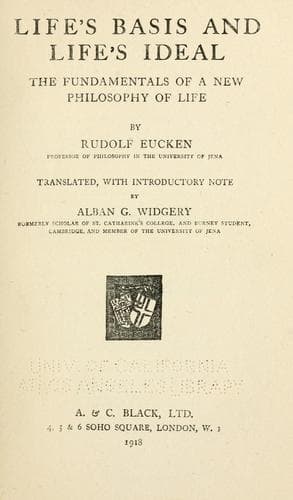
Life's Basis and Life's Ideal: The Fundamentals of a New Philosophy of LifeEucken, Rudolf
Philosophy
Life's Basis and Life's Ideal: The Fundamentals of a New Philosophy of Life
Eucken, Rudolf
Life; Ontology
This criticism of the statutes of society is not entirely without
reason. Such statutes do not in themselves constitute a morality, as it
is easy to imagine they do; but they only advocate a morality; as life
undergoes such far-reaching changes, these statutes must continually be
examined anew as to their validity and value. But this relativity does
not make them worthless, and does not justify their complete rejection
in favour of an absolute freedom on the part of individuals. We could
expect an elevation of life by such an effort for freedom only if we
might assume that the individuals are thoroughly noble, energetic, and
spiritually rich, and if in the relations between the sexes a state of
paradisiacal innocence reigned which only the evil arrangements of
society had disturbed. But this is a way of thinking which does more
honour to the hearts than to the heads of its advocates. He who takes
men as they really are and does not paint them in romantic colours, and
who at the same time recognises the dangers of a highly developed,
pleasure-seeking, and over-refined state of culture, will not despise
those social arrangements, notwithstanding their relativity, but value
them as an indispensable safeguard against the selfishness, the greed
for pleasure, and the instability of the mere individual--a safeguard
not only against the tyranny of externals but also for the individual
against himself. It is unfortunate enough that such safeguards are
necessary; but, as they are necessary, it is better to preserve and
improve them as much as possible than to reject them, and to expose
humanity to dangers that might throw it back into the condition of the
animals. Man is not better because he is painted more beautifully;
rather Pascal is right when he says: "L'homme n'est ni ange ni bête, et
le malheur veut, que qui veut faire l'ange fait la bête."
The tendency to think that man may be transformed inwardly and the whole
condition of life raised by changes in external organisation is most
definitely felt in the social movements of the age. In this there is a
clearly marked opposition to the earlier mode of thought, which, placing
a low estimate upon everything external, and finding greatness too
easily in disposition, overlooked how much the organisation of the
conditions of life means for men in whom the spiritual is only in
process of development; and, further, failed to notice that there is
also a strong movement from external to internal. Nevertheless, the fact
cannot be denied, notwithstanding all this, that the problems of the
whole and of man's inner nature require to be treated as of chief
importance. Otherwise, as Aristotle suggested, notwithstanding all the
alteration of conditions, the old problems will continually make their
appearance anew, and the substance of life might easily suffer from that
which was intended to improve its condition.
Public-domain text, read in full here on John Shaqi.
Reviews
Reviews
No reviews yet
Be the first to share your thoughts on this work.
Elsewhere in the archive
Join the Discussion
Join the discussion
Sign in to leave a comment or review.
Sign InorCreate an account