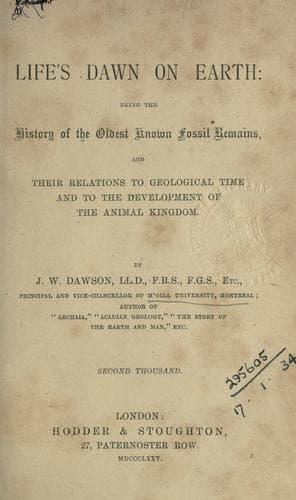
Life's Dawn on Earth: Being the history of the oldest known fossil remains, and their relations to geological time and to the development of the animal kingdomDawson, John William, Sir
History
Life's Dawn on Earth: Being the history of the oldest known fossil remains, and their relations to geological time and to the development of the animal kingdom
Dawson, John William, Sir
Life -- Origin; Paleontology -- Precambrian
"My discovery of similar organic remains in the serpentine-limestone
from near Passau was made in 1865, when I had returned from my
geological labours of the summer, and received the recently published
descriptions of Messrs. Logan, Dawson, etc. Small portions of this
rock, gathered in the progress of the Geological Survey in 1854,
and ever since preserved in my collection, having been submitted
to microscopic examination, confirmed in the most brilliant manner
the acute judgment of the Canadian geologists, and furnished
palæontological evidence that, notwithstanding the great distance which
separates Canada from Bavaria, the equivalent primitive rocks of the
two regions are characterized by similar organic remains; showing at
the same time that the law governing the definite succession of organic
life on the earth is maintained even in these most ancient formations.
The fragments of serpentine-limestone, or ophicalcite, in which I first
detected the existence of Eozoon, were like those described in Canada,
in which the lamellar structure is wanting, and offer only what Dr.
Carpenter has called an acervuline structure. For further confirmation
of my observations, I deemed it advisable, through the kindness of
Sir Charles Lyell, to submit specimens of the Bavarian rock to the
examination of that eminent authority, Dr. Carpenter, who, without any
hesitation, declared them to contain Eozoon.
"This fact being established, I procured from the quarries near Passau
as many specimens of the limestone as the advanced season of the year
would permit; and, aided by my diligent and skillful assistants,
Messrs. Reber and Schwager, examined them by the methods indicated by
Messrs. Dawson and Carpenter. In this way I soon convinced myself of
the general similarity of our organic remains with those of Canada.
Our examinations were made on polished sections and in portions etched
with dilute nitric acid, or, better, with warm acetic acid. The most
beautiful results were however obtained by etching moderately thin
sections, so that the specimens may be examined at will either by
reflected or transmitted light.
Public-domain text, read in full here on John Shaqi.
Reviews
Reviews
No reviews yet
Be the first to share your thoughts on this work.
Elsewhere in the archive
Join the Discussion
Join the discussion
Sign in to leave a comment or review.
Sign InorCreate an account