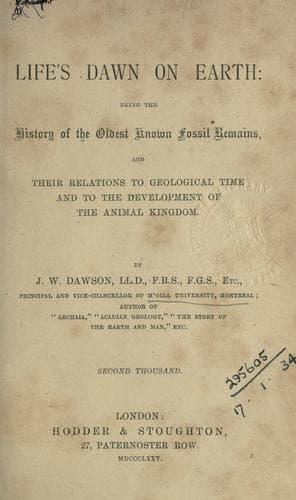
Life's Dawn on Earth: Being the history of the oldest known fossil remains, and their relations to geological time and to the development of the animal kingdomDawson, John William, Sir
History
Life's Dawn on Earth: Being the history of the oldest known fossil remains, and their relations to geological time and to the development of the animal kingdom
Dawson, John William, Sir
Life -- Origin; Paleontology -- Precambrian
"The great importance of this discovery cannot be clearly understood,
unless we first consider the various and conflicting opinions
and theories which had hitherto been maintained concerning the
origin of these primary rocks. Thus some, who consider them as the
first-formed crust of a previously molten globe, regard their apparent
stratification as a kind of concentric parallel structure, developed
in the progressive cooling of the mass from without. Others, while
admitting a similar origin of these rocks, suppose their division
into parallel layers to be due, like the lamination of clay-slates,
to lateral pressure. If we admit such views, the igneous origin of
schistose rocks becomes conceivable, and is in fact maintained by many.
"On the other hand, we have the school which, while recognising the
sedimentary origin of these crystalline schists, supposes them to
have been metamorphosed at a later period; either by the internal
heat, acting in the deeply buried strata; by the proximity of eruptive
rocks; or finally, through the agency of permeating waters charged with
certain mineral salts.
"A few geologists only have hitherto inclined to the opinion that
these crystalline schists, while possessing real stratification,
and sedimentary in their origin, were formed at a period when the
conditions were more favourable to the production of crystalline
materials than at present. According to this view, the crystalline
structure of these rocks is an original condition, and not one
superinduced at a later period by metamorphosis. In order, however,
to arrange and classify these ancient crystalline rocks, it becomes
necessary to establish by superposition, or by other evidence,
differences in age, such as are recognised in the more recent
stratified deposits. The discovery of similar organic remains,
occupying a determinate position in the stratification, in different
and remote portions of these primitive rocks, furnishes a powerful
argument in favour of the latter view, as opposed to the notion which
maintains the metamorphic origin of the various minerals and rocks of
these ancient formations; so that we may regard the direct formation of
these mineral elements, at least so far as these fossiliferous primary
limestones are concerned, as an established fact."
His first discovery is thus recorded, in terms which show the very
close resemblance of the Bavarian and Canadian Eozoic.
Public-domain text, read in full here on John Shaqi.
Reviews
Reviews
No reviews yet
Be the first to share your thoughts on this work.
Elsewhere in the archive
Join the Discussion
Join the discussion
Sign in to leave a comment or review.
Sign InorCreate an account