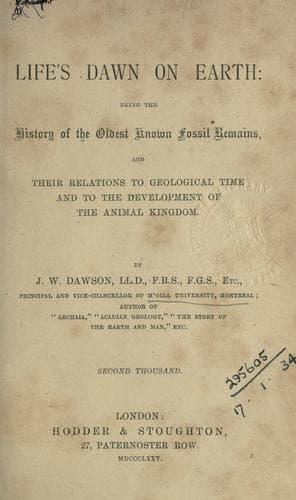
Life's Dawn on Earth: Being the history of the oldest known fossil remains, and their relations to geological time and to the development of the animal kingdomDawson, John William, Sir
History
Life's Dawn on Earth: Being the history of the oldest known fossil remains, and their relations to geological time and to the development of the animal kingdom
Dawson, John William, Sir
Life -- Origin; Paleontology -- Precambrian
In the rocks extending from the Lower Silurian and perhaps from the
Upper Cambrian to the Devonian inclusive, the type and function of
Eozoon are continued by the Stromatoporæ, and in the earlier part of
this time these are accompanied by the Archæocyathids, and by another
curious form, more nearly allied to the latter than to Eozoon, the
_Receptaculites_. These curious and beautiful fossils, which sometimes
are a foot in diameter, consist, like Archæocyathus, of an outer and
inner coat enclosing a cavity; but these coats are composed of square
plates with pores at the corners, and they are connected by hollow
pillars passing in a regular manner from the outer to the inner coat.
They have been regarded by Salter as Foraminifers, while Billings
considers their nearest analogues to be the seed-like germs of some
modern silicious sponges. On the whole, if not Foraminifera, they must
have been organisms intermediate between these and sponges, and they
certainly constitute one of the most beautiful and complex types of
the ancient Protozoa, showing the wonderful perfection to which these
creatures attained at a very early period. (Figs. 46, 47, 48.)
I might trace these ancient forms of foraminiferal life further up in
the geological series, and show how in the Carboniferous there are
nummulitic shells conforming to the general type of Eozoon, and in some
cases making up the mass of great limestones.[AL] Further, in the great
chalk series and its allied beds, and in the Lower Tertiary, there are
not only vast foraminiferal limestones, but gigantic species reminding
us of Stromatopora and Eozoon.[AM] Lastly, more diminutive species are
doing similar work on a great scale in the modern ocean. Thus we may
gather up the broken links of the chain of foraminiferal life, and
affirm that Eozoon has never wanted some representative to uphold its
family and function throughout all the vast lapse of geological time.
[Footnote AL: _Fusulina_, as recently described by Carpenter,
_Archæodiscus_ of Brady, and the Nummulite recently found in the
Carboniferous of Belgium.]
[Footnote AM: _Parkeria_ and _Loftusia_ of Carpenter.]
NOTES TO CHAPTER VI.
(A.) Stromatoporidæ, Etc.
For the best description of Archæocyathus, I may refer to _The
Palæozoic Fossils of Canada_, by Mr. Billings, vol. i. There also,
and in Mr. Salter's memoir in _The Decades of the Canadian Survey_,
will be found all that is known of the structure of Receptaculites.
For the American Stromatoporæ I may refer to Winchell's paper in the
_Proceedings of the American Association_, 1866; to Professor Hall's
Descriptions of New Species of Fossils from Iowa, _Report of the
State Cabinet, Albany_, 1872; and to the Descriptions of Canadian
Species by Dr. Nicholson, in his _Report on the Palæontology of
Ontario_, 1874.
Public-domain text, read in full here on John Shaqi.
Reviews
Reviews
No reviews yet
Be the first to share your thoughts on this work.
Elsewhere in the archive
Join the Discussion
Join the discussion
Sign in to leave a comment or review.
Sign InorCreate an account