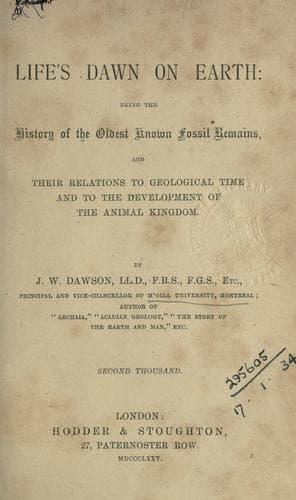
Life's Dawn on Earth: Being the history of the oldest known fossil remains, and their relations to geological time and to the development of the animal kingdomDawson, John William, Sir
History
Life's Dawn on Earth: Being the history of the oldest known fossil remains, and their relations to geological time and to the development of the animal kingdom
Dawson, John William, Sir
Life -- Origin; Paleontology -- Precambrian
The genus Stromatopora of Goldfuss was defined by him as consisting
of laminæ of a solid and porous character, alternating and
contiguous, and constituting a hemispherical or sub-globose mass.
In this definition, the porous strata are really those of the
fossil, the alternating solid strata being the stony filling of the
chambers; and the descriptions of subsequent authors have varied
according as, from the state of preservation of the specimens or
other circumstances, the original laminæ or the filling of the spaces
attracted their attention. In the former case the fossil could be
described as consisting of laminæ made up of interlaced fibrils of
calcite, radiating from vertical pillars which connect the laminæ.
In the latter case, the laminæ, appear as solid plates, separated
by very narrow spaces, and perforated with round vertical holes
representing the connecting pillars. These Stromatoporæ range from
the Lower Silurian to the Devonian, inclusive, and many species have
been described; but their limits are not very definite, though there
are undoubtedly remarkable differences in the distances of the laminæ
and in their texture, and in the smooth or mammillated character
of the masses. Hall's genus Stromatocerium belongs to these forms,
and D'Orbigny's genus Sparsispongia refers to mammillated species,
sometimes with apparent oscula.
Phillip's genus Caunopora was formed to receive specimens with
concentric cellular layers traversed by "long vermiform cylindrical
canals;" while Winchell's genus Cœnostroma includes species with
these vermiform canals arranged in a radiate manner, diverging from
little eminences in the concentric laminæ. The distinction between
these last genera does not seem to be very clear, and may depend
on the state of preservation of the specimens. A more important
distinction appears to exist between those that have a single
vertical canal from which the subordinate canals diverge, and those
that have groups of such canals.
Some species of the Cœnostroma group have very dense calcareous
laminæ traversed by the canals; but it does not seem that any
distinction has yet been made between the proper wall and the
intermediate skeleton; and most observers have been prevented from
attending to such structures by the prevailing idea that these
fossils are either corals or sponges, while the state of preservation
of the more delicate tissues is often very imperfect.
(B.) Localities of Eozoon, or of Limestones supposed to contain it.
Public-domain text, read in full here on John Shaqi.
Reviews
Reviews
No reviews yet
Be the first to share your thoughts on this work.
Elsewhere in the archive
Join the Discussion
Join the discussion
Sign in to leave a comment or review.
Sign InorCreate an account