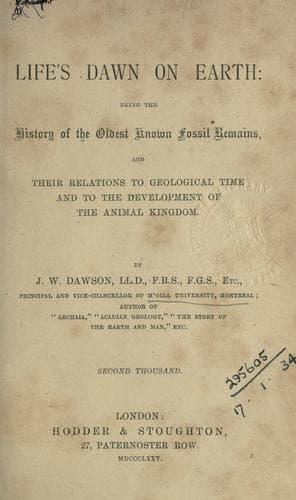
Life's Dawn on Earth: Being the history of the oldest known fossil remains, and their relations to geological time and to the development of the animal kingdomDawson, John William, Sir
History
Life's Dawn on Earth: Being the history of the oldest known fossil remains, and their relations to geological time and to the development of the animal kingdom
Dawson, John William, Sir
Life -- Origin; Paleontology -- Precambrian
I confess that I feel disposed to treat very tenderly the position of
objectors. The facts I have stated make large demands on the faith
of the greater part even of naturalists. Very few geologists or
naturalists have much knowledge of the structure of foraminiferal
shells, or would be able under the microscope to recognise them with
certainty. Nor have they any distinct ideas of the appearances of such
structures under different kinds of preservation and mineralisation.
Further, they have long been accustomed to regard the so-called Azoic
rocks as not only destitute of organic remains, but as being in such
a state of metamorphism that these could not have been preserved had
they existed. Few, therefore, are able intelligently to decide for
themselves, and so they are called on to trust to the investigations
of others, and on their testimony to modify in a marked degree their
previous beliefs as to the duration of life on our planet. In these
circumstances it is rather wonderful that the researches made with
reference to Eozoon have met with so general acceptance, and that the
resurrection of this ancient inhabitant of the earth has not aroused
more of the sceptical tendency of our age.
It must not be lost sight of, however, that in such cases there may
exist a large amount of undeveloped and even unconscious scepticism,
which shows itself not in active opposition, but merely in quietly
ignoring this great discovery, or regarding it with doubt, as an
uncertain or unestablished point in science. Such scepticism may best
be met by the plain and simple statements in the foregoing chapters,
and by the illustrations accompanying them. It may nevertheless be
profitable to review some of the points referred to, and to present
some considerations making the existence of Laurentian life less
anomalous than may at first sight be supposed. One of these is the
fact that the discovery of Eozoon brings the rocks of the Laurentian
system into more full harmony with the other geological formations. It
explains the origin of the Laurentian limestones in consistency with
that of similar rocks in the later periods, and in like manner it helps
us to account for the graphite and sulphides and iron ores of these old
rocks. It shows us that no time was lost in the introduction of life
on the earth. Otherwise there would have been a vast lapse of time in
which, while the conditions suitable to life were probably present, no
living thing existed to take advantage of these conditions. Further, it
gives a more simple beginning of life than that afforded by the more
complex fauna of the Primordial age; and this is more in accordance
with what we know of the slow and gradual introduction of new forms of
living things during the vast periods of Palæozoic time. In connection
with this it opens a new and promising field of observation in the
older rocks, and if this should prove fertile, its exploration may
Public-domain text, read in full here on John Shaqi.
Reviews
Reviews
No reviews yet
Be the first to share your thoughts on this work.
Elsewhere in the archive
Join the Discussion
Join the discussion
Sign in to leave a comment or review.
Sign InorCreate an account