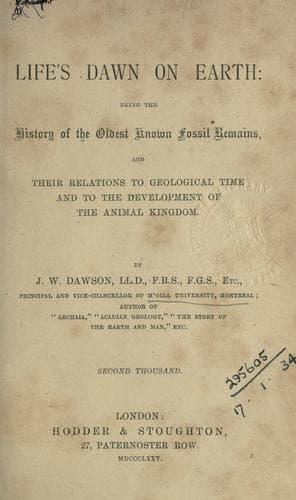
Life's Dawn on Earth: Being the history of the oldest known fossil remains, and their relations to geological time and to the development of the animal kingdomDawson, John William, Sir
History
Life's Dawn on Earth: Being the history of the oldest known fossil remains, and their relations to geological time and to the development of the animal kingdom
Dawson, John William, Sir
Life -- Origin; Paleontology -- Precambrian
In Canada the principal localities of Eozoon Canadense are at
Grenville, Petite Nation, the Calumets Rapids, Burgess, Tudor, and
Madoc. At the two last places the fossil occurs in beds which may be
on a somewhat higher horizon than the others. Mr. Vennor has recently
found specimens which have the general form of Eozoon, though the
minute structure is not preserved, at Dalhousie, in Lanark Co.,
Ontario. One specimen from this place is remarkable from having been
mineralized in part by a talcose mineral associated with serpentine.
I have examined specimens from Chelmsford, in Massachusetts, and from
Amity and Warren County, New York, the latter from the collection of
Professor D. S. Martin, which show the canals of Eozoon in a fair
state of preservation, though the specimens are fragmental, and do
not show the laminated structure.
In European specimens of limestones of Laurentian age, from Tunaberg
and Fahlun in Sweden, and from the Western Islands of Scotland, I
have hitherto failed to recognise the characteristic structure of
the fossil. Connemara specimens have also failed to afford me any
satisfactory results, and specimens of a serpentine limestone from
the Alps, collected by M. Favre, and communicated to me by Dr. Hunt,
though in general texture they much resemble acervuline Eozoon, do
not show its minute structures.
[Illustration:
Plate VII.
_Untouched nature-print of part of a large specimen of Eozoon, from
Petite Nation._
The lighter portions are less perfect than in the original, owing to
the finer laminæ of serpentine giving way. The dark band at one side is
one of the deep lacunæ or oscula.]
CHAPTER VII.
OPPONENTS AND OBJECTIONS.
The active objectors to the animal nature of Eozoon have been few,
though some of them have returned to the attack with a pertinacity and
determination which would lead one to believe that they think the most
sacred interests of science to be dependent on the annihilation of this
proto-foraminifer. I do not propose here to treat of the objections in
detail. I have presented the case of Eozoon on its own merits, and on
these it must stand. I may merely state that the objectors strive to
account for the existence of Eozoon by purely mineral deposition, and
that the complicated changes which they require to suppose are perhaps
the strongest indirect evidence for the necessity of regarding the
structures as organic. The reader who desires to appreciate this may
consult the notes to this chapter.[AN]
[Footnote AN: Also Rowney and King's papers in _Journal Geological
Society_, August, 1866; and _Proceedings Irish Academy_, 1870 and 1871.]
Public-domain text, read in full here on John Shaqi.
Reviews
Reviews
No reviews yet
Be the first to share your thoughts on this work.
Elsewhere in the archive
Join the Discussion
Join the discussion
Sign in to leave a comment or review.
Sign InorCreate an account