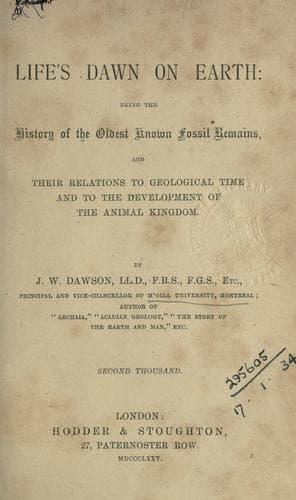
Life's Dawn on Earth: Being the history of the oldest known fossil remains, and their relations to geological time and to the development of the animal kingdomDawson, John William, Sir
History
Life's Dawn on Earth: Being the history of the oldest known fossil remains, and their relations to geological time and to the development of the animal kingdom
Dawson, John William, Sir
Life -- Origin; Paleontology -- Precambrian
"This subject opens up several interesting fields of chemical,
physiological, and geological inquiry. One of these relates to the
conclusions stated by Dr. Hunt as to the probable existence of a
large amount of carbonic acid in the Laurentian atmosphere, and of
much carbonate of lime in the seas of that period, and the possible
relation of this to the abundance of certain low forms of plants and
animals. Another is the comparison already instituted by Professor
Huxley and Dr. Carpenter, between the conditions of the Laurentian and
those of the deeper parts of the modern ocean. Another is the possible
occurrence of other forms of animal life than Eozoon and Annelids,
which I have stated in my paper of 1864, after extensive microscopic
study of the Laurentian limestones, to be indicated by the occurrence
of calcareous fragments, differing in structure from Eozoon, but at
present of unknown nature. Another is the effort to bridge over, by
further discoveries similar to that of the _Eozoon Bavaricum_ of
Gümbel, the gap now existing between the life of the Lower Laurentian
and that of the Primordial Silurian or Cambrian period. It is scarcely
too much to say that these inquiries open up a new world of thought and
investigation, and hold out the hope of bringing us into the presence
of the actual origin of organic life on our planet, though this may
perhaps be found to have been Prelaurentian. I would here take the
opportunity of stating that, in proposing the name Eozoon for the
first fossil of the Laurentian, and in suggesting for the period the
name "Eozoic," I have by no means desired to exclude the possibility
of forms of life which may have been precursors of what is now to us
the dawn of organic existence. Should remains of still older organisms
be found in those rocks now known to us only by pebbles in the
Laurentian, these names will at least serve to mark an important stage
in geological investigation."
Public-domain text, read in full here on John Shaqi.
Reviews
Reviews
No reviews yet
Be the first to share your thoughts on this work.
Elsewhere in the archive
Join the Discussion
Join the discussion
Sign in to leave a comment or review.
Sign InorCreate an account