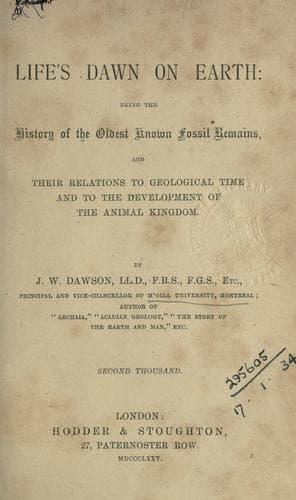
Life's Dawn on Earth: Being the history of the oldest known fossil remains, and their relations to geological time and to the development of the animal kingdomDawson, John William, Sir
History
Life's Dawn on Earth: Being the history of the oldest known fossil remains, and their relations to geological time and to the development of the animal kingdom
Dawson, John William, Sir
Life -- Origin; Paleontology -- Precambrian
But what if the result of such investigations should be to produce
more sceptics, or to bring to light mineral structures so resembling
Eozoon as to throw doubt upon the whole of the results detailed in
these chapters? I can fancy that this might be the first consequence,
more especially if the investigations were in the hands of persons
more conversant with minerals than with fossils; but I see no reason
to fear the ultimate results. In any case, no doubt, the value of the
researches hitherto made may be diminished. It is always the fate of
discoverers in Natural Science, either to be followed by opponents who
temporarily or permanently impugn or destroy the value of their new
facts, or by other investigators who push on the knowledge of facts and
principles so far beyond their standpoint that the original discoveries
are cast into the shade. This is a fatality incident to the progress of
scientific work, from which no man can be free; and in so far as such
matters are concerned, we must all be content to share the fate of the
old fossils whose history we investigate, and, having served our day
and generation to give place to others. If any part of our work should
stand the fire of discussion let us be thankful. One thing at least is
certain, that such careful surveys as those in the Laurentian rocks
of Canada which led to the discovery of Eozoon, and such microscopic
examinations as those by which it has been worked up and presented to
the public, cannot fail to yield good results of one kind or another.
Already the attention excited by the controversies about Eozoon, by
attracting investigators to the study of various microscopic and
imitative forms in rocks, has promoted the advancement of knowledge,
and must do so still more. For my own part, though I am not content to
base all my reputation on such work as I have done with respect to this
old fossil, I am willing at least to take the responsibility of the
results I have announced, whatever conclusions may be finally reached;
and in the consciousness of an honest effort to extend the knowledge
of nature, to look forward to a better fame than any that could result
from the most successful and permanent vindication of every detail
of our scientific discoveries, even if they could be pushed to a
point which no subsequent investigation in the same difficult line of
research would be able to overpass.
Contenting myself with these general remarks, I shall, for the benefit
of those who relish geological controversy, append to this chapter a
summary of the objections urged by the most active opponents of the
animal nature of Eozoon, with the replies that may be or have been
given; and I now merely add (in fig. 49) a magnified camera tracing of
a portion of a lamina of Eozoon with its canals and tubuli, to show
more fully the nature of the structures in controversy.
Public-domain text, read in full here on John Shaqi.
Reviews
Reviews
No reviews yet
Be the first to share your thoughts on this work.
Elsewhere in the archive
Join the Discussion
Join the discussion
Sign in to leave a comment or review.
Sign InorCreate an account