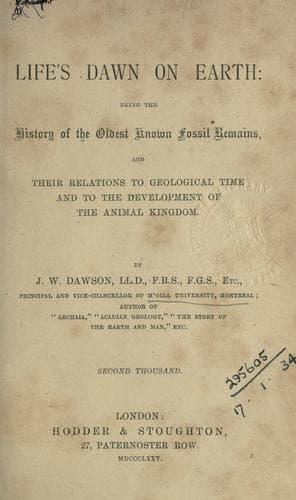
Life's Dawn on Earth: Being the history of the oldest known fossil remains, and their relations to geological time and to the development of the animal kingdom — John Shaqi
Life's Dawn on Earth: Being the history of the oldest known fossil remains, and their relations to geological time and to the development of the animal kingdomDawson, John William, Sir
History
Life's Dawn on Earth: Being the history of the oldest known fossil remains, and their relations to geological time and to the development of the animal kingdom
Dawson, John William, Sir
Life -- Origin; Paleontology -- Precambrian
All the constituents of the Laurentian series are in that state known
to geologists as metamorphic. They were once sandstones, clays, and
limestones, such as the sea now deposits, or such as form the common
plebeian rocks of everyday plains and hills and coast sections. Being
extremely old, however, they have been buried deep in the bowels of
the earth under the newer deposits, and hardened by the action of
pressure and of heat and heated water. Whether this heat was part
of that originally belonging to the earth when a molten mass, and
still existing in its interior after aqueous rocks had begun to form
on its surface, or whether it is a mere mechanical effect of the
intense compression which these rocks have suffered, may be a disputed
question; but the observations of Sorby and of Hunt (the former in
connection with the microscopic structure of rocks, and the latter
in connection with the chemical conditions of change) show that no
very excessive amount of heat would be required. These observations
and those of Daubrée indicate that crystallization like that of the
Laurentian rocks might take place at a temperature of not over 370° of
the centigrade thermometer.
The study of those partial alterations which take place in the
vicinity of volcanic and older aqueous masses of rock confirms these
conclusions, so that we may be said to know the precise conditions
under which sediments may be hardened into crystalline rocks, while
the bedded character and the alternations of different layers in the
Laurentian rocks, as well as the indications of contemporary marine
life which they contain, show that they actually are such altered
sediments. (See Note D.)
Public-domain text, read in full here on John Shaqi.
Reviews
Reviews
No reviews yet
Be the first to share your thoughts on this work.
Join the Discussion
Join the discussion
Sign in to leave a comment or review.
Sign InorCreate an account