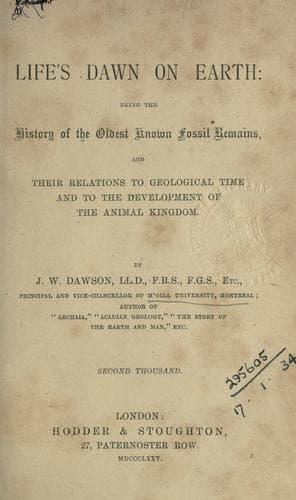
Life's Dawn on Earth: Being the history of the oldest known fossil remains, and their relations to geological time and to the development of the animal kingdomDawson, John William, Sir
History
Life's Dawn on Earth: Being the history of the oldest known fossil remains, and their relations to geological time and to the development of the animal kingdom
Dawson, John William, Sir
Life -- Origin; Paleontology -- Precambrian
They are also occasionally
fringed with minute crystals, especially in those specimens in which
the calcite has been partially replaced with other minerals. Fig. 3
shows an example of faulting of the proper wall, an appearance not
infrequently observed; and it also shows a vein chrysotile crossing the
line of fault, and not itself affected by it--a clear evidence of its
posterior origin. Figs. 4 and 5 are examples of specimens having the
canals filled with dolomite, and showing extremely fine canals in the
interstices of the others: an appearance observed only in the thicker
parts of the skeleton, and when these are very well preserved. These
dolomitized portions require some precautions for their observation,
either in slices or decalcified specimens, but when properly managed
they show the structures in very great perfection. The specimen in fig.
5 is from an abnormally thick portion of intermediate skeleton, having
unusually thick canals, and referred to in a previous chapter.
One object which I have in view in thus minutely directing attention
to these illustrations, is to show the nature of the misapprehensions
which may occur in examining specimens of this kind, and at the same
time the certainty which may be attained when proper precautions are
taken. I may add that such structures as those referred to are best
seen in extremely thin slices, and that the observer must not expect
that every specimen will exhibit them equally well. It is only by
preparing and examining many specimens that the best results can be
obtained. It often happens that one specimen is required to show well
one part of the structures, and a different one to show another; and
previous to actual trial, it is not easy to say which portion of
the structures any particular fragment will show most clearly. This
renders it somewhat difficult to supply one's friends with specimens.
Really good slices can be prepared only from the best material and by
skilled manipulators; imperfect slices may only mislead; and rough
specimens may not be properly prepared by persons unaccustomed to the
work, or if so prepared may not turn out satisfactory, or may not be
skilfully examined. These difficulties, however, Eozoon shares with
other specimens in micro-geology, and I have experienced similar
disappointments in the case of fossil wood.
In conclusion of this part of the subject, and referring to the notes
appended to this chapter for further details, I would express the hope
that those who have hitherto opposed the interpretation of Eozoon as
organic, and to whose ability and honesty of purpose I willingly bear
testimony, will find themselves enabled to acknowledge at least the
reasonable probability of that interpretation of these remarkable forms
and structures.
NOTES TO CHAPTER VII.
(A.) Objections of Profs. King and Rowney.
_Trans. Royal Irish Academy, July, 1869._[AO]
[Footnote AO: Reprinted in the _Annals and Magazine of Natural
History_, May, 1874.]
Public-domain text, read in full here on John Shaqi.
Reviews
Reviews
No reviews yet
Be the first to share your thoughts on this work.
Elsewhere in the archive
Join the Discussion
Join the discussion
Sign in to leave a comment or review.
Sign InorCreate an account