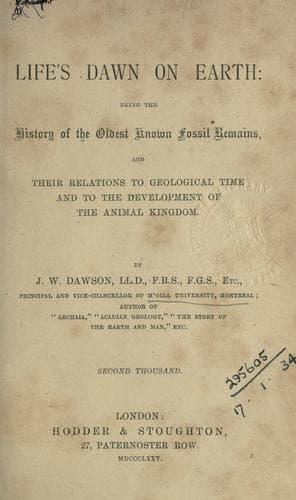
Life's Dawn on Earth: Being the history of the oldest known fossil remains, and their relations to geological time and to the development of the animal kingdomDawson, John William, Sir
History
Life's Dawn on Earth: Being the history of the oldest known fossil remains, and their relations to geological time and to the development of the animal kingdom
Dawson, John William, Sir
Life -- Origin; Paleontology -- Precambrian
The following summary, given by these authors, may be taken as
including the substance of their objections to the animal nature of
Eozoon. I shall give them in their words and follow them with short
answers to each.
"1st. The serpentine in ophitic rocks has been shown to present
appearances which can only be explained on the view that it undergoes
structural and chemical changes, causing it to pass into variously
subdivided states, and etching out the resulting portions into a
variety of forms--grains and plates, with lobulated or segmented
surfaces--fibres and aciculi--simple and branching configurations.
Crystals of malacolite, often associated with the serpentine,
manifest some of these changes in a remarkable degree.
"2nd. The 'intermediate skeleton' of Eozoon (which we hold to be
the calcareous matrix of the above lobulated grains, etc.) is
completely paralleled in various crystalline rocks--notably marble
containing grains of coccolite (Aker and Tyree), pargasite (Finland),
chondrodite (New Jersey, etc.)
"3rd. The 'chamber casts' in the acervuline variety of Eozoon are
more or less paralleled by the grains of the mineral silicates in the
pre-cited marbles.
"4th. The 'chamber casts' being composed occasionally of loganite and
malacolite, besides serpentine, is a fact which, instead of favouring
their organic origin, as supposed, must be held as a proof of their
having been produced by mineral agencies; inasmuch as these three
silicates have a close pseudomorphic relationship, and may therefore
replace one another in their naturally prescribed order.
"5th. Dr. Gümbel, observing rounded, cylindrical, or tuberculated
grains of coccolite and pargasite in crystalline calcareous marbles,
considered them to be 'chamber casts,' or of organic origin. We have
shown that such grains often present crystalline planes, angles, and
edges; a fact clearly proving that they were originally simple or
compound crystals that have undergone external decretion by chemical
or solvent action.
"6th. We have adduced evidences to show that the 'nummuline layer' in
its typical condition--that is, consisting of cylindrical aciculi,
separated by interspaces filled with calcite--has originated directly
from closely packed fibres; these from chrysotile or asbestiform
serpentine; this from incipiently fibrous serpentine; and the latter
from the same mineral in its amorphous or structureless condition.
"7th. The 'nummuline layer,' in its typical condition, unmistakably
occurs in cracks or fissures, both in Canadian and Connemara ophite.
"8th. The 'nummuline layer' is paralleled by the fibrous coat which
is occasionally present on the surface of grains of chondrodite.
Public-domain text, read in full here on John Shaqi.
Reviews
Reviews
No reviews yet
Be the first to share your thoughts on this work.
Elsewhere in the archive
Join the Discussion
Join the discussion
Sign in to leave a comment or review.
Sign InorCreate an account