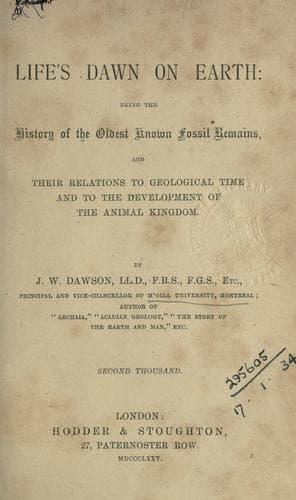
Life's Dawn on Earth: Being the history of the oldest known fossil remains, and their relations to geological time and to the development of the animal kingdomDawson, John William, Sir
History
Life's Dawn on Earth: Being the history of the oldest known fossil remains, and their relations to geological time and to the development of the animal kingdom
Dawson, John William, Sir
Life -- Origin; Paleontology -- Precambrian
12th. If this is true of the Aker marble, then it must contain
Eozoon; and specimens of the Amity limestone which I have examined,
certainly contain large fragments of Eozoon.
13th. The configuration of the canal system is quite definite,
though varying in coarseness and fineness. It is not known to occur
independently of the forms of Eozoon except in fragmental deposits.
14th. The argument is not that they are "occasionally found together
in ophite," but that they are found together in specimens preserved
by different minerals, and in such a way as to show that all these
minerals have filled chambers, canals, and tubuli, previously
existing in a skeleton of limestone.
15th. The lamination of Eozoon is not like that of any rock, but
a strictly limited and definite form, comparable with that of
Stromatopora.
16th. This I pass over, as a mere captious criticism of modes of
expression used by Dr. Carpenter.
17th. Dr. Hunt, whose knowledge of chemical geology should give
the greatest weight to his judgment, maintains the deposition of
serpentine and loganite to have taken place in a manner similar to
that of jollyte and glauconite in undoubted fossils: and this would
seem to be a clear deduction from the facts he has stated, and from
the chemical character of the substances. My own observations of the
mode of occurrence of serpentine in the Eozoon limestones lead me to
the same result.
18th. Dr. Hunt's arguments on the subject, as recently presented
in his _Papers on Chemistry and Geology_, need only be studied by
any candid and competent chemist or mineralogist to lead to a very
different conclusion from that of the objectors.
19th. This is a mere statement of opinion. The fact remains that the
chambers and canals are sometimes filled with calcite.
20th. That the occurrence of Eozoon in crystalline limestones is
"utterly fatal" to its claims to organic origin can be held only by
those who are utterly ignorant of the frequency with which organic
remains are preserved in highly crystalline limestones of all ages.
In addition to other examples mentioned above, I may state that the
curious specimen of Cœnostroma from the Guelph limestone figured
in Chapter VI., has been converted into a perfectly crystalline
dolomite, while its canals and cavities have been filled with
calcite, since weathered out.
21st. This limited occurrence is an assumption contrary to facts.
It leaves out of account the Tudor specimens, and also the abundant
occurrence of the Stromatoporoid successors of Eozoon in the
Silurian and Devonian. Further, even if the Eozoon were limited to
the Laurentian, this would not be remarkable; and since all the
Laurentian rocks known to us are more or less altered, it could not
in that case occur in unaltered rocks.
Public-domain text, read in full here on John Shaqi.
Life's Dawn on Earth: Being the history of the oldest known fossil remains, and their relations to geological time and to the development of the animal kingdom — John Shaqi
Reviews
Reviews
No reviews yet
Be the first to share your thoughts on this work.
Elsewhere in the archive
Join the Discussion
Join the discussion
Sign in to leave a comment or review.
Sign InorCreate an account