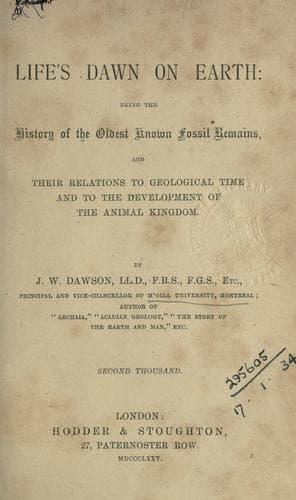
Life's Dawn on Earth: Being the history of the oldest known fossil remains, and their relations to geological time and to the development of the animal kingdomDawson, John William, Sir
History
Life's Dawn on Earth: Being the history of the oldest known fossil remains, and their relations to geological time and to the development of the animal kingdom
Dawson, John William, Sir
Life -- Origin; Paleontology -- Precambrian
2nd. Some of the things stated to parallel the intermediate skeleton
of Eozoon, are probably themselves examples of that skeleton. Others
have been shown to have no resemblance to it.
3rd. The words "more or less" indicate the precise value of this
statement, in a question of comparison between mineral and organic
structures. So the prismatic structure of satin-spar may be said
"more or less" to resemble that of a shell, or of the cells of a
Stenopora.
4th. This overlooks the filling of chamber casts with pyroxene,
dolomite, or limestone. Even in the case of loganite this objection
is of no value unless it can be applied equally to the similar
silicates which fill cavities of fossils[AQ] in the Silurian
limestones and in the green-sand.
[Footnote AQ: See for a full discussion of this subject Dr. Hunt's
"Papers" above referred to.]
5th. Dr. Gümbel's observations are those of a highly skilled and
accurate observer. Even if crystalline forms appear in "chamber
casts," this is as likely to be a result of the injury of organic
structures by crystallization, as of the partial effacement of
crystals by other actions. Crystalline faces occur abundantly in many
undoubted fossil woods and corals; and crystals not unfrequently
cross and interfere with the structures in such specimens.
6th. On the contrary, the Canadian specimens prove clearly that the
veins of chrysotile have been filled subsequently to the existence of
Eozoon in its present state, and that there is no connection whatever
between them and the Nummuline wall.
7th. This I have never seen in all my examinations of Eozoon. The
writers must have mistaken veins of fibrous serpentine for the
nummuline wall.
8th. Only if such grains of chondrodite are themselves casts of
foraminiferal chambers. But Messrs. King and Rowney have repeatedly
figured mere groups of crystals as examples of the nummuline wall.
9th. Dr. Carpenter has shown that this objection depends on a
misconception of the structure of modern Foraminifera, which show
similar appearances.
10th. That disseminated crystals occur in the Eozoon limestones is a
familiar fact, and one paralleled in many other more or less altered
organic limestones. Foreign bodies also occur in the chambers filled
with loganite and other minerals; but these need not any more be
confounded with the pillars and walls connecting the laminæ than
the sand filling a dead coral with its lamellæ. Further, it is well
known that foreign bodies are often contained both in the testa and
chambers even of recent Foraminifera.
11th. The canal system is not always filled with serpentine or
malacolite; and when filled with pyroxene, dolomite, or calcite, the
forms are the same. The irregularities spoken of are perhaps more
manifest in the serpentine specimens, because this mineral has in
places encroached on or partially replaced the calcite walls.
Public-domain text, read in full here on John Shaqi.
Reviews
Reviews
No reviews yet
Be the first to share your thoughts on this work.
Elsewhere in the archive
Join the Discussion
Join the discussion
Sign in to leave a comment or review.
Sign InorCreate an account