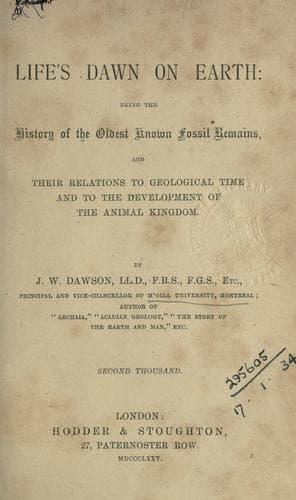
Life's Dawn on Earth: Being the history of the oldest known fossil remains, and their relations to geological time and to the development of the animal kingdomDawson, John William, Sir
History
Life's Dawn on Earth: Being the history of the oldest known fossil remains, and their relations to geological time and to the development of the animal kingdom
Dawson, John William, Sir
Life -- Origin; Paleontology -- Precambrian
In 1864, additional specimens having been obtained by the Survey,
slices were submitted to the writer, in which he at once detected
a well-marked canal-system, and stated, decidedly, his belief that
the forms were organic and foraminiferal. The announcement of this
discovery was first made by Sir W. E. Logan, in _Silliman's Journal_
for 1864. So far, the facts obtained and stated related to definite
forms mineralised by loganite, serpentine, pyroxene, dolomite, and
calcite. But before publishing these facts in detail, extensive
series of sections of all the Laurentian limestones, and of those
of the altered Quebec group of the Green Mountain range, were made,
under the direction of Sir W. E. Logan and Dr. Hunt, and examined
microscopically. Specimens were also decalcified by acids, and
subjected to chemical examination by Dr. Sterry Hunt. The result was
the conviction that the definite laminated forms must be organic,
and further, that there exist in the Laurentian limestones fragments
of such forms retaining their structure, and also other fragments,
probably organic, but distinct from Eozoon. These conclusions were
submitted to the Geological Society of London, in 1864, after the
specimens on which they were based had been shown to Dr. Carpenter
and Professor T. R. Jones, the former of whom detected in some of
the specimens an additional foraminiferal structure--that of the
tubulation of the proper wall, which I had not been able to make out.
Subsequently, in rocks at Tudor, of somewhat later age than those
of the Lower Laurentian at Grenville, similar structures were found
in limestones not more metamorphic than many of those which retain
fossils in the Silurian system. I make this historical statement in
order to place the question in its true light, and to show that it
relates to the organic origin of certain definite mineral masses,
exhibiting, not only the external forms of fossils, but also their
internal structure.
In opposition to these facts, and to the careful deductions drawn
from them, the authors of the paper under consideration maintain that
the structures are mineral and crystalline. I believe that in the
present state of science such an attempt to return to the doctrine
of "plastic-force" as a mode of accounting for fossils would not
be tolerated for a moment, were it not for the great antiquity and
highly crystalline condition of the rocks in which the structures
are found, which naturally create a prejudice against the idea of
their being fossiliferous. That the authors themselves feel this is
apparent from the slight manner in which they state the leading facts
above given, and from their evident anxiety to restrict the question
to the mode of occurrence of serpentine in limestone, and to ignore
the specimens of Eozoon preserved under different mineral conditions.
Public-domain text, read in full here on John Shaqi.
Reviews
Reviews
No reviews yet
Be the first to share your thoughts on this work.
Elsewhere in the archive
Join the Discussion
Join the discussion
Sign in to leave a comment or review.
Sign InorCreate an account