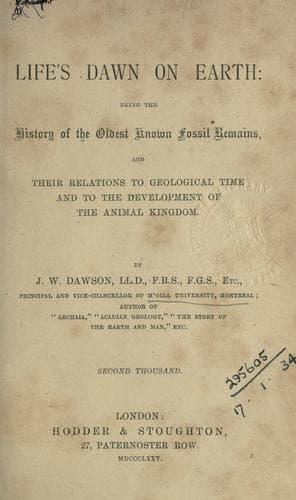
Life's Dawn on Earth: Being the history of the oldest known fossil remains, and their relations to geological time and to the development of the animal kingdomDawson, John William, Sir
History
Life's Dawn on Earth: Being the history of the oldest known fossil remains, and their relations to geological time and to the development of the animal kingdom
Dawson, John William, Sir
Life -- Origin; Paleontology -- Precambrian
2. With reference to the general form of Eozoon and its structure
on the large scale, I would call attention to two admissions of
the authors of the paper, which appear to me to be fatal to their
case:--First, they admit, at page 533 [_Proceedings_, vol. x.],
their "inability to explain satisfactorily" the alternating layers
of carbonate of lime and other minerals in the typical specimens of
Canadian Eozoon. They make a feeble attempt to establish an analogy
between this and certain concentric concretionary layers; but the
cases are clearly not parallel, and the laminæ of the Canadian
Eozoon present connecting plates and columns not explicable on any
concretionary hypothesis. If, however, they are unable to explain the
lamellar structure alone, as it appeared to Logan in 1859, is it not
rash to attempt to explain it away now, when certain minute internal
structures, corresponding to what might have been expected on the
hypothesis of its organic origin, are added to it? If I affirm that
a certain mass is the trunk of a fossil tree, and another asserts
that it is a concretion, but professes to be unable to account for
its form and its rings of growth, surely his case becomes very weak
after I have made a slice of it, and have shown that it retains the
structure of wood.
Next, they appear to admit that if specimens occur wholly composed
of carbonate of lime, their theory will fall to the ground. Now such
specimens do exist. They treat the Tudor specimen with scepticism as
probably "strings of segregated calcite." Since the account of that
specimen was published, additional fragments have been collected, so
that new slices have been prepared. I have examined these with care,
and am prepared to affirm that the chambers in these specimens are
filled with a dark-coloured limestone not more crystalline than is
usual in the Silurian rocks, and that the chamber walls are composed
of carbonate of lime, with the canals filled with the same material,
except where the limestone filling the chambers has penetrated into
parts of the larger ones. I should add that the stratigraphical
researches of Mr. Vennor, of the Canadian Survey, have rendered it
probable that the beds containing these fossils, though unconformably
underlying the Lower Silurian, overlie the Lower Laurentian of the
locality, and are, therefore, probably Upper Laurentian, or perhaps
Huronian, so that the Tudor specimens may approach in age to Gümbel's
Eozoon Bavaricum.[AR]
[Footnote AR: I may now refer in addition to the canals filled with
calcite and dolomite, detected by Dr. Carpenter and myself in specimens
from Petite Nation, and mentioned in a previous chapter. See also Plate
VIII.]
Public-domain text, read in full here on John Shaqi.
Reviews
Reviews
No reviews yet
Be the first to share your thoughts on this work.
Elsewhere in the archive
Join the Discussion
Join the discussion
Sign in to leave a comment or review.
Sign InorCreate an account