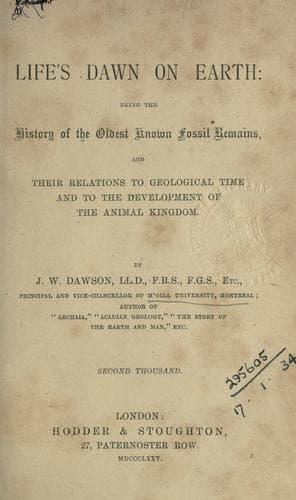
Life's Dawn on Earth: Being the history of the oldest known fossil remains, and their relations to geological time and to the development of the animal kingdomDawson, John William, Sir
History
Life's Dawn on Earth: Being the history of the oldest known fossil remains, and their relations to geological time and to the development of the animal kingdom
Dawson, John William, Sir
Life -- Origin; Paleontology -- Precambrian
and, as all must see, is the gist of the whole matter.
"Messrs. King and Rowney, it will be observed, assume the existence
of calcite as a replacement pseudomorph after serpentine, but give
no evidence of the possibility of such pseudomorphs. Both Rose and
Bischof regard serpentine itself as in all cases, of pseudomorphous
origin, and as the last result of the changes of a number of mineral
species, but give us no example of the pseudomorphous alteration of
serpentine itself. It is, according to Bischof, the very insolubility
and unalterability of serpentine which cause it to appear as the
final result of the change of so many mineral species. Delesse,
moreover, in his carefully prepared table of pseudomorphous minerals,
in which he has resumed the results of his own and all preceding
observers, does not admit the pseudomorphic replacement of serpentine
by calcite, nor indeed by any other species.[AV] If, then, such
pseudomorphs exist, it appears to be a fact hitherto unobserved,
and our authors should at least have given us some evidence of this
remarkable case of pseudomorphism by which they seek to support their
singular hypothesis.
[Footnote AV: _Annales des Mines_, 5, xvi., 317.]
"I hasten to say, however, that I reject with Scheerer, Delesse
and Naumann, a great part of the supposed cases of mineral
pseudomorphism, and do not even admit the pseudomorphous origin of
serpentine itself, but believe that this, with many other related
silicates, has been formed by direct chemical precipitation. This
view, which our authors do me the honour to criticise, was set
forth by me in 1860 and 1861,[AW] and will be found noticed more
in detail in the _Geological Report of Canada_, for 1866, p. 229.
I have there and elsewhere maintained that 'steatite, serpentine,
pyroxene, hornblende, and in many cases garnet, epidote, and other
silicated minerals, are formed by a crystallization and molecular
re-arrangement of silicates, generated by chemical processes in
waters at the earth's surface.'[AX]
[Footnote AW: _Amer. Journ. Science_ (2), xxix., 284; xxxii., 286.]
[Footnote AX: _Ibid._, xxxvii., 266; xxxviii., 183.]
Public-domain text, read in full here on John Shaqi.
Reviews
Reviews
No reviews yet
Be the first to share your thoughts on this work.
Elsewhere in the archive
Join the Discussion
Join the discussion
Sign in to leave a comment or review.
Sign InorCreate an account