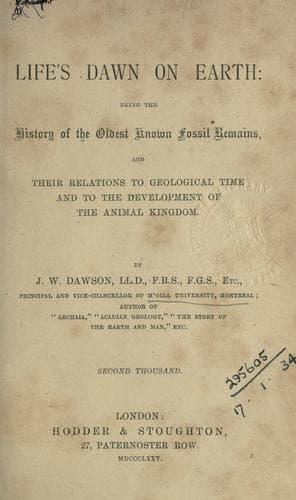
Life's Dawn on Earth: Being the history of the oldest known fossil remains, and their relations to geological time and to the development of the animal kingdomDawson, John William, Sir
History
Life's Dawn on Earth: Being the history of the oldest known fossil remains, and their relations to geological time and to the development of the animal kingdom
Dawson, John William, Sir
Life -- Origin; Paleontology -- Precambrian
"This view, which at once explains the origin of all these bedded
rocks, and the fact that their constituent mineral species, like
silica and carbonate of lime, replace the perishable matter of
organic forms, is designated by Messrs. King and Rowney 'as so
completely destitute of the characters of a scientific hypothesis
as to be wholly unworthy of consideration,' and they speak of my
attempt to maintain this hypothesis as 'a total collapse.' How far
this statement is from the truth my readers shall judge. My views
as to the origin of serpentine and other silicated minerals were
set forth by me as above in 1860-1864, before anything was known
of the mineralogy of Eozoon, and were forced upon me by my studies
of the older crystalline schists of North America. Naumann had
already pointed out the necessity of some such hypothesis when he
protested against the extravagances of the pseudomorphist school,
and maintained that the beds of various silicates found in the
crystalline schists are original deposits, and not formed by an
epigenic process (_Geognosie_, ii., 65, 154, and _Bull. Soc. Geol.
de France_, 2, xviii., 678). This conclusion of Naumann's I have
attempted to explain and support by numerous facts and observations,
which have led me to the hypothesis in question. Gümbel, who accepts
Naumann's view, sustains my hypothesis of the origin of these rocks
in a most emphatic manner,[AY] and Credner, in discussing the genesis
of the Eozoic rocks, has most ably defended it.[AZ] So much for my
theoretical views so contemptuously denounced by Messrs. King and
Rowney, which are nevertheless unhesitatingly adopted by the two
geologists of the time who have made the most special studies of the
rocks in question,--Gümbel in Germany, and Credner in North America.
[Footnote AY: _Proc. Royal Bavarian Acad._ for 1866, translated in
_Can. Naturalist_, iii., 81.]
[Footnote AZ: _Die Gliederung der Eozoischen Formations gruppe
Nord.-Amerikas,--a Thesis defended before the University of Leipzig,
March 15, 1869_, by Dr. Hermann Credner. Halle, 1869, p. 53.]
Public-domain text, read in full here on John Shaqi.
Reviews
Reviews
No reviews yet
Be the first to share your thoughts on this work.
Elsewhere in the archive
Join the Discussion
Join the discussion
Sign in to leave a comment or review.
Sign InorCreate an account