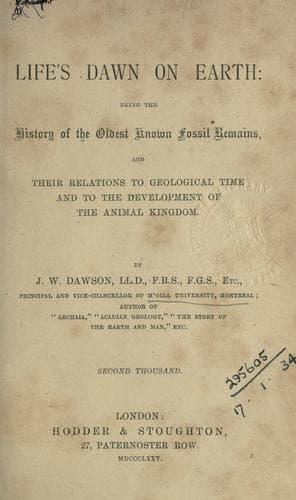
Life's Dawn on Earth: Being the history of the oldest known fossil remains, and their relations to geological time and to the development of the animal kingdomDawson, John William, Sir
History
Life's Dawn on Earth: Being the history of the oldest known fossil remains, and their relations to geological time and to the development of the animal kingdom
Dawson, John William, Sir
Life -- Origin; Paleontology -- Precambrian
"It would be a thankless task to follow Messrs. King and Rowney
through their long paper, which abounds in statements as unsound as
those I have just exposed, but I cannot conclude without calling
attention to one misconception of theirs as to my view of the origin
of limestones. They quote Professor Hull's remark to the effect that
the researches of the Canadian geologists and others have shown that
the oldest known limestones of the world owe their origin to Eozoon,
and remark that the existence of great limestone beds in the Eozoic
rocks seems to have influenced Lyell, Ramsay, and others in admitting
the received view of Eozoon. Were there no other conceivable source
of limestones than Eozoon or similar calcareous skeletons, one might
suppose that the presence of such rocks in the Laurentian system
could have thus influenced these distinguished geologists, but
there are found beneath the Eozoon horizon two great formations of
limestone in which this fossil has never been detected. When found,
indeed, it owes its conservation in a readily recognisable form to
the fact, that it was preserved by the introduction of serpentine
at the time of its growth. Above the unbroken Eozoon reefs are
limestones made up apparently of the debris of Eozoon thus preserved
by serpentine, and there is no doubt that this calcareous rhizopod,
growing in water where serpentine was not in process of formation,
might, and probably did, build up pure limestone beds like those
formed in later times from the ruins of corals and crinoids. Nor
is there anything inconsistent in this with the assertion which
Messrs. King and Rowney quote from me, viz., that the popular notion
that _all limestone formations_ owe their origin to organic life is
based upon a fallacy. The idea that marine organisms originate the
carbonate of lime of their skeletons, in a manner somewhat similar to
that in which plants generate the organic matter of theirs, appears
to be commonly held among certain geologists. It cannot, however,
be too often repeated that animals only appropriate the carbonate
of lime which is furnished them by chemical reaction. Were there
no animals present to make use of it, the carbonate of lime would
accumulate in natural waters till these became saturated, and would
then be deposited in an insoluble form; and although thousands of
feet of limestone have been formed from the calcareous skeletons
of marine animals, it is not less true that great beds of ancient
marble, like many modern travertines and tufas, have been deposited
without the intervention of life, and even in waters from which
living organisms were probably absent. To illustrate this with the
parallel case of silicious deposits, there are great beds made
up of silicious shields of diatoms. These during their lifetime
extracted from the waters the dissolved silica, which, but for their
Public-domain text, read in full here on John Shaqi.
Reviews
Reviews
No reviews yet
Be the first to share your thoughts on this work.
Elsewhere in the archive
Join the Discussion
Join the discussion
Sign in to leave a comment or review.
Sign InorCreate an account