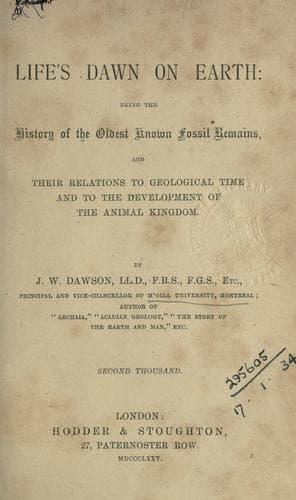
Life's Dawn on Earth: Being the history of the oldest known fossil remains, and their relations to geological time and to the development of the animal kingdomDawson, John William, Sir
History
Life's Dawn on Earth: Being the history of the oldest known fossil remains, and their relations to geological time and to the development of the animal kingdom
Dawson, John William, Sir
Life -- Origin; Paleontology -- Precambrian
Fig. 2.--Junction of a canal and the proper wall. Lettering as in
Fig. 1.
Fig. 3.--Proper wall shifted by a fault, and more recent chrysotile
vein not faulted. Lettering as in Fig. 1.
Fig. 4.--Large and small canals filled with dolomite.
Fig. 5.--Abnormally thick portion of intermediate skeleton, with
large tubes and small canals filled with dolomite.]
CHAPTER VIII.
THE DAWN-ANIMAL AS A TEACHER IN SCIENCE.
The thoughts suggested to the philosophical naturalist by the
contemplation of the dawn of life on our planet are necessarily many
and exciting, and the subject has in it the materials for enabling the
general reader better to judge of some of the theories of the origin of
life agitated in our time. In this respect our dawn-animal has scarcely
yet had justice; and we may not be able to render this in these pages.
Let us put it into the witness-box, however, and try to elicit its
testimony as to the beginnings of life.
Looking down from the elevation of our physiological and mental
superiority, it is difficult to realize the exact conditions in which
life exists in creatures so simple as the Protozoa. There may perhaps
be higher intelligences that find it equally difficult to realize how
life and reason can manifest themselves in such poor houses of clay
as those we inhabit. But placing ourselves near to these creatures,
and entering as it were into sympathy with them, we can understand
something of their powers and feelings. In the first place it is plain
that they can vigorously, if roughly, exercise those mechanical,
chemical, and vegetative powers of life which are characteristic of
the animal. They can seize, swallow, digest, and assimilate food; and,
employing its albuminous parts in nourishing their tissues, can burn
away the rest in processes akin to our respiration, or reject it from
their system. Like us, they can subsist only on food which the plant
has previously produced; for in this world, from the beginning of time,
the plant has been the only organism which could use the solar light
and heat as forces to enable it to turn the dead elements of matter
into living, growing tissues, and into organic compounds capable of
nourishing the animal. Like us, the Protozoa expend the food which
they have assimilated in the production of animal force, and in doing
so cause it to be oxidized, or burnt away, and resolved again into
dead matter. It is true that we have much more complicated apparatus
for performing these functions, but it does not follow that this gives
us much real superiority, except relatively to the more difficult
conditions of our existence. The gourmand who enjoys his dinner may
have no more pleasure in the act than the Amœba which swallows a
Diatom; and for all that the man knows of the subsequent processes to
which the food is subjected, his interior might be a mass of jelly,
with extemporised vacuoles, like that of his humble fellow-animal. The
Public-domain text, read in full here on John Shaqi.
Reviews
Reviews
No reviews yet
Be the first to share your thoughts on this work.
Elsewhere in the archive
Join the Discussion
Join the discussion
Sign in to leave a comment or review.
Sign InorCreate an account