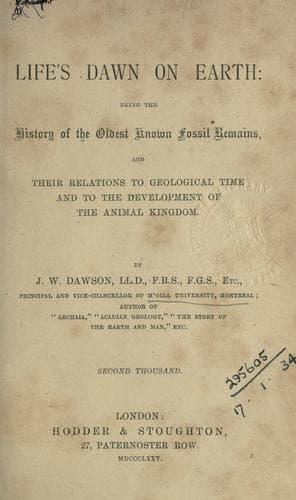
Life's Dawn on Earth: Being the history of the oldest known fossil remains, and their relations to geological time and to the development of the animal kingdomDawson, John William, Sir
History
Life's Dawn on Earth: Being the history of the oldest known fossil remains, and their relations to geological time and to the development of the animal kingdom
Dawson, John William, Sir
Life -- Origin; Paleontology -- Precambrian
workman or the athlete has bones and muscles of vastly complicated
structure, but to him the muscular act is as simple and unconscious a
process as the sending out of a pseudopod to a Protozoon. The clay is
after all the same, and there may be as much credit to the artist in
making a simple organism with varied powers, as a more complex frame
for doing nicer work. It is a weakness of humanity to plume itself on
advantages not of its own making, and to treat its superior gifts as
if they were the result of its own endeavours. The truculent traveller
who illustrated his boast of superiority over the Indian by comparing
his rifle with the bow and arrows of the savage, was well answered by
the question, "Can you make a rifle?" and when he had to answer, "No,"
by the rejoinder, "Then I am at least better than you, for I can make
my bow and arrows." The Amœba or the Eozoon is probably no more than we
its own creator; but if it could produce itself out of vegetable matter
or out of inorganic substances, it might claim in so far a higher
place in the scale of being than we; and as it is, it can assert equal
powers of digestion, assimilation, and motion, with much less of bodily
mechanism.
In order that we may feel, a complicated apparatus of nerves and
brain-cells has to be constructed and set to work; but the Protozoon,
without any distinct brain, is all brain, and its sensation is simply
direct. Thus vision in these creatures is probably performed in a rough
way by any part of their transparent bodies, and taste and smell are no
doubt in the same case. Whether they have any perception of sound as
distinct from the mere vibrations ascertained by touch, we do not know.
Here also we are not far removed above the Protozoa, especially those
of us to whom touch, seeing, and hearing are mere feelings, without
thought or knowledge of the apparatus employed. We might so far as
well be Amœbas. As we rise higher we meet with more differences. Yet
it is evident that our gelatinous fellow-being can feel pain, dread
danger, desire possessions, enjoy pleasure, and in a simple unconscious
way entertain many of the appetites and passions that affect ourselves.
The wonder is that with so little of organization it can do so much.
Yet, perhaps, life can manifest itself in a broader and more intense
way where there is little organization; and a highly strung and
complex organism is not so much a necessary condition of a higher life
as a mere means of better adapting it to its present surroundings.
Those philosophies which identify the thinking mind with the material
organism, must seem outrageous blunders to an Amœba on the one hand, or
to an angel on the other, could either be enabled to understand them;
which, however, is not very probable, as they are too intimately bound
up with the mere prejudices incident to the present condition of our
humanity. In any case the Protozoa teach us how much of animal function
Public-domain text, read in full here on John Shaqi.
Reviews
Reviews
No reviews yet
Be the first to share your thoughts on this work.
Elsewhere in the archive
Join the Discussion
Join the discussion
Sign in to leave a comment or review.
Sign InorCreate an account