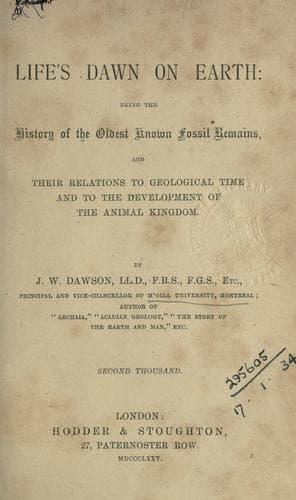
Life's Dawn on Earth: Being the history of the oldest known fossil remains, and their relations to geological time and to the development of the animal kingdomDawson, John William, Sir
History
Life's Dawn on Earth: Being the history of the oldest known fossil remains, and their relations to geological time and to the development of the animal kingdom
Dawson, John William, Sir
Life -- Origin; Paleontology -- Precambrian
really in no better position than the savage who quails before the
thunderstorm, or rejoices in the solar warmth, and seeing no force or
power beyond, fancies himself in the immediate presence of his God. In
Eozoon we must discern not only a mass of jelly, but a being endowed
with that higher vital force which surpasses vegetable life and also
physical and chemical forces; and in this animal energy we must see an
emanation from a Will higher than our own, ruling vitality itself; and
this not merely to the end of constructing the skeleton of a Protozoon,
but of elaborating all the wonderful developments of life that were to
follow in succeeding ages, and with reference to which the production
and growth of this creature were initial steps. It is this mystery of
design which really constitutes the "profound significance" of the
foraminiferal skeleton.
Another phenomenon of animality forced upon our notice by the Protozoa
is that of the conditions of life in animals not individual, as we
are, but aggregative and cumulative in indefinite masses. What, for
instance, the relations to each other of the Polyps, growing together
in a coral mass, of the separate parts of a Sponge, or the separate
cells of a Foraminifer, or of the sarcode mass of an indefinitely
spread out Stromatopora or Bathybius. In the case of the Polyps, we
may believe that there is special sensation in the tentacles and
oral opening of each individual, and that each may experience hunger
when in want, or satisfaction when it is filled with food, and that
injuries to one part of the mass may indirectly affect other parts,
but that the nutrition of the whole mass may be as much unfelt by the
individual Polyps as the processes going on in our own bones are by
us. So in the case of a large Sponge or Foraminifer, there may be some
special sensation in individual cells, pseudopods, or segments, and
the general sensation may be very limited, while unconscious living
powers pervade the whole. In this matter of aggregation of animals we
have thus various grades. The Foraminifers and Sponges present us with
the simplest of all, and that which most resembles the aggregation of
buds in the plant. The Polyps and complex Bryozoons present a higher
and more specialised type; and though the bilateral symmetry which
obtains in the higher animals is of a different nature, it still at
least reminds us of that multiplication of similar parts which we see
in the lower grades of being. It is worthy of notice here that the
lower animals which show aggregative tendencies present but imperfect
indications, or none at all, of bilateral symmetry. Their bodies, like
those of plants, are for the most part built up around a central axis,
or they show tendencies to spiral modes of growth.
Public-domain text, read in full here on John Shaqi.
Reviews
Reviews
No reviews yet
Be the first to share your thoughts on this work.
Elsewhere in the archive
Join the Discussion
Join the discussion
Sign in to leave a comment or review.
Sign InorCreate an account