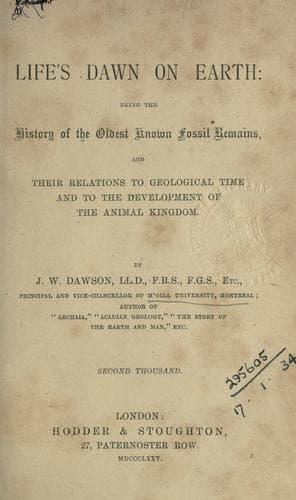
Life's Dawn on Earth: Being the history of the oldest known fossil remains, and their relations to geological time and to the development of the animal kingdomDawson, John William, Sir
History
Life's Dawn on Earth: Being the history of the oldest known fossil remains, and their relations to geological time and to the development of the animal kingdom
Dawson, John William, Sir
Life -- Origin; Paleontology -- Precambrian
may be fulfilled by a very simple organism, and warn us against the
fallacy that creatures of this simple structure are necessarily nearer
to inorganic matter, and more easily developed from it than beings of
more complex mould.
A similar lesson is taught by the complexity of their skeletons.
We speak in a crude unscientific way of these animals accumulating
calcareous matter, and building up reefs of limestone. We must,
however, bear in mind that they are as dependent on their food for
the materials of their skeletons as we are, and that their crusts
grow in the interior of the sarcode just as our bones do within our
bodies. The provision even for nourishing the interior of the skeleton
by tubuli and canals is in principle similar to that involved in the
Haversian canals, cells, and canalicules of bone. The Amœba of course
knows neither more nor less of this than the average Englishman.
It is altogether a matter of unconscious growth. The process in
the Protozoa strikes some minds, however, as the more wonderful of
the two. It is, says an eminent modern physiologist, a matter of
"profound significance" that this "particle of jelly [the sarcode
of a Foraminifer] is capable of guiding physical forces in such a
manner as to give rise to these exquisite and almost mathematically
arranged structures." Respecting the structures themselves there is no
exaggeration in this. No arch or dome framed by human skill is more
perfect in beauty or in the realization of mechanical ideas than the
tests of some Foraminifera, and none is so complete and wonderful in
its internal structure. The particle of jelly, however, is a figure of
speech. The body of the humblest Foraminifer is much more than this.
It is an organism with divers parts, as we have already seen in a
previous chapter, and it is endowed with the mysterious forces of life
which in it guide the physical forces, just as they do in building
up phosphate of lime in our bones, or indeed just as the will of the
architect does in building a palace. The profound significance which
this has, reaches beyond the domain of the physical and vital, even to
the spiritual. It clings to all our conceptions of living things: quite
as much, for example, to the evolution of an animal with all its parts
from a one-celled germ, or to the connection of brain-cells with the
manifestations of intelligence. Viewed in this way, we may share with
the author of the sentence I have quoted his feeling of veneration in
the presence of this great wonder of animal life, "burning, and not
consumed," nay, building up, and that in many and beautiful forms. We
may realize it most of all in the presence of the organism which was
perhaps the first to manifest on our planet these marvellous powers.
We must, however, here also, beware of that credulity which makes too
many thinkers limit their conceptions altogether to physical force
in matters of this kind. The merely materialistic physiologist is
Public-domain text, read in full here on John Shaqi.
Reviews
Reviews
No reviews yet
Be the first to share your thoughts on this work.
Elsewhere in the archive
Join the Discussion
Join the discussion
Sign in to leave a comment or review.
Sign InorCreate an account