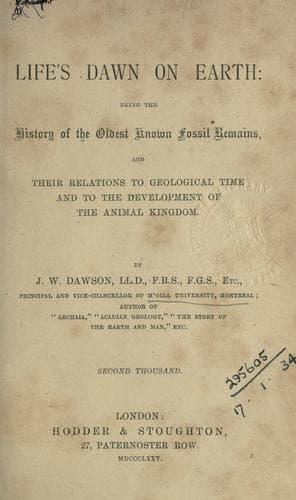
Life's Dawn on Earth: Being the history of the oldest known fossil remains, and their relations to geological time and to the development of the animal kingdomDawson, John William, Sir
History
Life's Dawn on Earth: Being the history of the oldest known fossil remains, and their relations to geological time and to the development of the animal kingdom
Dawson, John William, Sir
Life -- Origin; Paleontology -- Precambrian
But we further find that, while the first though not the only organic
gatherers of limestone from the ocean waters, they have had to do, not
merely with the formation of calcareous sediments, but also with that
of silicious deposits. The greenish silicate called glauconite, or
green-sand, is found to be associated with much of the foraminiferal
slime now accumulating in the ocean, and also with the older deposits
of this kind now consolidated in chalks and similar rocks. This name
glauconite is, as Dr. Hunt has shown, employed to designate not only
the hydrous silicate of iron and potash, which perhaps has the best
right to it, but also compounds which contain in addition large
percentages of alumina, or magnesia, or both; and one glauconite from
the Tertiary limestones near Paris, is said to be a true serpentine,
or hydrous silicate of magnesia.[BA] Now the association of such
substances with Foraminifera is not purely accidental. Just as a
fragment of decaying wood, imbedded in sediment, has the power of
decomposing soluble silicates carried to it by water, and parting with
its carbon in the form of carbonic acid, in exchange for the silica,
and thus replacing, particle by particle, the carbon of the wood
with silicon, so that at length it becomes petrified into a flinty
mass, so the sarcode of a Foraminifer, which is a more dense kind of
animal matter than is usually supposed, can in like manner abstract
silica from the surrounding water or water-soaked sediment. From some
peculiarity in the conditions of the case, however, our Protozoon
usually becomes petrified with a hydrous silicate instead of with pure
silica. The favourable conditions presented by the deep sea for the
combination of silica with bases, may perhaps account in part for
this. But whatever the cause, it is usual to find fossil Foraminifera
with their sarcode replaced by such material. We also find beds of
glauconite retaining the forms of Foraminifera, while the calcareous
tests of these have been removed, apparently by acid waters.
[Footnote BA: Berthier, quoted by Hunt.]
Public-domain text, read in full here on John Shaqi.
Reviews
Reviews
No reviews yet
Be the first to share your thoughts on this work.
Elsewhere in the archive
Join the Discussion
Join the discussion
Sign in to leave a comment or review.
Sign InorCreate an account