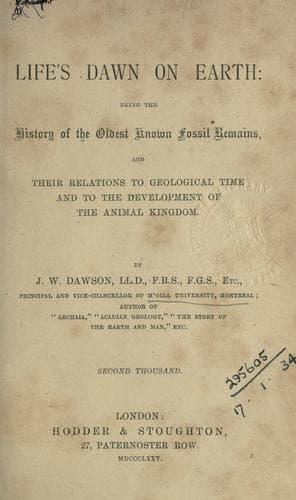
Life's Dawn on Earth: Being the history of the oldest known fossil remains, and their relations to geological time and to the development of the animal kingdomDawson, John William, Sir
History
Life's Dawn on Earth: Being the history of the oldest known fossil remains, and their relations to geological time and to the development of the animal kingdom
Dawson, John William, Sir
Life -- Origin; Paleontology -- Precambrian
One consideration which, though conjectural, deserves notice, is
connected with the food of these humble animals. They are known to feed
to a large extent on minute plants, the Diatoms, and other organisms
having silica in their skeletons or cell-walls, and consequently
soluble silicates in their juices. The silicious matter contained
in these organisms is not wanted by the Foraminifera for their own
skeletons, and will therefore be voided by them as an excrementitious
matter. In this way, where Foraminifera greatly abound, there may be a
large production of soluble silica and silicates, in a condition ready
to enter into new and insoluble compounds, and to fill the cavities
and pores of dead shells. Thus glauconite and even serpentine may,
in a certain sense, be a sort of foraminiferal coprolitic matter or
excrement. Of course it is not necessary to suppose that this is the
only source of such materials. They may be formed in other ways; but I
suggest this as at least a possible link of connection.
Whether or not the conjecture last mentioned has any validity, there
is another and most curious bond of connection between oceanic
Protozoa and silicious deposits. Professor Wyville Thompson reports
from the _Challenger_ soundings, that in certain areas of the South
Pacific the ordinary foraminiferal ooze is replaced by a peculiar red
clay, which he attributes to the action of water laden with carbonic
acid, in removing all the lime, and leaving this red mud as a sort
of ash, composed of silica, alumina, and iron oxide. Now this is in
all probability a product of the decomposition and oxidation of the
glauconitic matter contained in the ooze. Thus we learn that when areas
on which calcareous deposits have been accumulated by Protozoa, are
invaded by cold arctic or antarctic waters charged with carbonic acid,
the carbonate of lime may be removed, and the glauconite left, or even
the latter may be decomposed, leaving silicious, aluminous, and other
deposits, which may be quite destitute of any organic structures, or
retain only such remnants of them as have been accidentally or by
their more resisting character protected from destruction.[BB] In this
way it may be possible that many silicious rocks of the Laurentian
and Primordial ages, which now show no trace of organization, may be
indirectly products of the action of life. When the recent deposits
discovered by the _Challenger_ dredgings shall have been more fully
examined, we may perhaps have the means of distinguishing such rocks,
and thus of still further enlarging our conceptions of the part played
by Protozoa in the drama of the earth's history. In any case it seems
plain that beds of green-sand and similar hydrous silicates may be the
residue of thick deposits of foraminiferal limestone or chalky matter,
and that these silicates may in their turn be oxidised and decomposed,
leaving beds of apparently inorganic clay. Such beds may finally be
Public-domain text, read in full here on John Shaqi.
Reviews
Reviews
No reviews yet
Be the first to share your thoughts on this work.
Elsewhere in the archive
Join the Discussion
Join the discussion
Sign in to leave a comment or review.
Sign InorCreate an account