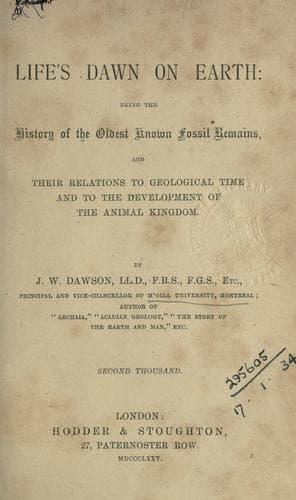
Life's Dawn on Earth: Being the history of the oldest known fossil remains, and their relations to geological time and to the development of the animal kingdomDawson, John William, Sir
History
Life's Dawn on Earth: Being the history of the oldest known fossil remains, and their relations to geological time and to the development of the animal kingdom
Dawson, John William, Sir
Life -- Origin; Paleontology -- Precambrian
We are still more deeply impressed with this when we bring into view
the great physical changes which have occurred since the dawn of life.
When we consider that the skeletons of Eozoon contribute to form the
oldest hills of our continents; that they have been sealed up in solid
marble, and that they are associated with hard crystalline rocks
contorted in the most fantastic manner; that these rocks have almost
from the beginning of geological time been undergoing waste to supply
the material of new formations; that they have witnessed innumerable
subsidences and elevations of the continents; and that the greatest
mountain chains of the earth have been built up from the sea since
Eozoon began to exist,--we acquire a most profound impression of the
persistence of the lower forms of animal life, and know that mountains
may be removed and continents swept away and replaced, before the least
of the humble gelatinous Protozoa can finally perish. Life may be a
fleeting thing in the individual, but as handed down through successive
generations of beings, and as a constant animating power in successive
organisms, it appears, like its Creator, eternal.
This leads to another and very serious question. How long did lineal
descendants of Eozoon exist, and do they still exist? We may for the
present consider this question apart from ideas of derivation and
elevation into higher planes of existence. Eozoon as a species and
even as a genus may cease to exist with the Eozoic age, and we have no
evidence whatever that Archæocyathus, Stromatopora, or Receptaculites
are its modified descendants. As far as their structures inform us,
they may as much claim to be original creations as Eozoon itself.
Still descendants of Eozoon may have continued to exist, though we
have not yet met with them. I should not be surprised to hear of a
veritable specimen being some day dredged alive in the Atlantic or
the Pacific. It is also to be observed that in animals so simple as
Eozoon many varieties may appear, widely different from the original.
In these the general form and habit of life are the most likely things
to change, the minute structures much less so. We need not, therefore,
be surprised to find its descendants diminishing in size or altering
in general form, while the characters of the fine tubulation and of
the canal system would remain. We need not wonder if any sessile
Foraminifer of the Nummuline group should prove to be a descendant
of Eozoon. It would be less likely that a Sponge or a Foraminifer of
the Rotaline type should originate from it. If one could only secure
a succession of deep-sea limestones with Foraminifers, extending all
the way from the Laurentian to the present time, I can imagine nothing
more interesting than to compare the whole series, with the view of
ascertaining the limits of descent with variation, and the points where
new forms are introduced. We have not yet such a series, but it may be
Public-domain text, read in full here on John Shaqi.
Reviews
Reviews
No reviews yet
Be the first to share your thoughts on this work.
Elsewhere in the archive
Join the Discussion
Join the discussion
Sign in to leave a comment or review.
Sign InorCreate an account