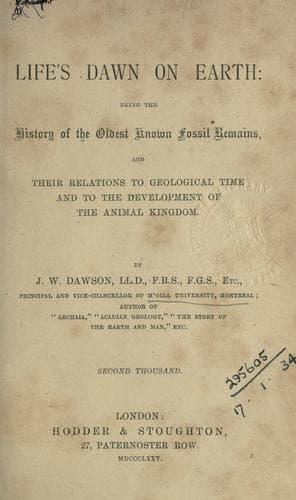
Life's Dawn on Earth: Being the history of the oldest known fossil remains, and their relations to geological time and to the development of the animal kingdomDawson, John William, Sir
History
Life's Dawn on Earth: Being the history of the oldest known fossil remains, and their relations to geological time and to the development of the animal kingdom
Dawson, John William, Sir
Life -- Origin; Paleontology -- Precambrian
obtained; and as Foraminifera are eminently cosmopolitan, occurring
over vastly wide areas of sea-bottom, and are very variable, they would
afford a better test of theories of derivation than any that can be
obtained from the more locally distributed and less variable animals
of higher grade. I was much struck with this recently, in examining a
series of Foraminifera from the Cretaceous of Manitoba, and comparing
them with the varietal forms of the same species in the interior of
Nebraska, 500 miles to the south, and with those of the English chalk
and of the modern seas. In all these different times and places we had
the same species. In all they existed under so many varietal forms
passing into each other, that in former times every species had been
multiplied into several. Yet in all, the identical varietal forms
were repeated with the most minute markings alike. Here were at once
constancy the most remarkable and variations the most extensive. If we
dwell on the one to the exclusion of the other, we reach only one-sided
conclusions, imperfect and unsatisfactory. By taking both in connection
we can alone realize the full significance of the facts. We cannot
yet obtain such series for all geological time; but it may even now
be worth while to inquire, What do we know as to any modification in
the case of the primeval Foraminifers, whether with reference to the
derivation from them of other Protozoa or of higher forms of life?
There is no link whatever in geological fact to connect Eozoon with any
of the Mollusks, Radiates, or Crustaceans of the succeeding Primordial.
What may be discovered in the future we cannot conjecture; but at
present these stand before us as distinct creations. It would of course
be more probable that Eozoon should be the ancestor of some of the
Foraminifera of the Primordial age, but strangely enough it is very
dissimilar from all these except Stromatopora; and here, as already
stated, the evidence of minute structure fails to a great extent, and
Eozoon Bavaricum of the Huronian age scarcely helps to bridge over the
gap which yawns in our imperfect geological record. Of actual facts,
therefore, we have none; and those evolutionists who have regarded the
dawn-animal as an evidence in their favour, have been obliged to have
recourse to supposition and assumption.
Public-domain text, read in full here on John Shaqi.
Reviews
Reviews
No reviews yet
Be the first to share your thoughts on this work.
Elsewhere in the archive
Join the Discussion
Join the discussion
Sign in to leave a comment or review.
Sign InorCreate an account