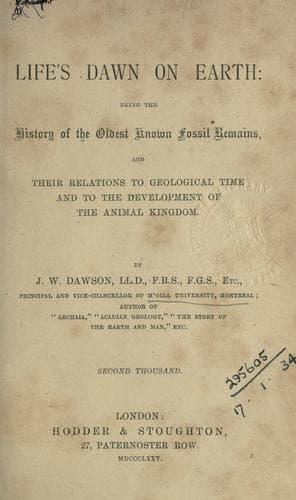
Life's Dawn on Earth: Being the history of the oldest known fossil remains, and their relations to geological time and to the development of the animal kingdomDawson, John William, Sir
History
Life's Dawn on Earth: Being the history of the oldest known fossil remains, and their relations to geological time and to the development of the animal kingdom
Dawson, John William, Sir
Life -- Origin; Paleontology -- Precambrian
Taking the ground of the derivationist, it is convenient to assume
(1) that Eozoon was either the first or nearly the first of animals,
and that, being a Protozoan of simple structure, it constitutes an
appropriate beginning of life; (2) that it originated from some
unexplained change in the protoplasmic or albuminous matter of some
humble plant, or directly from inorganic matter, or at least was
descended from some creature only a little more simple which had
being in this way; (3) that it had in itself unlimited capacities
for variation and also for extension in time; (4) that it tended to
multiply rapidly, and at last so to occupy the ocean that a struggle
for existence arose; (5) that though at first, from the very nature
of its origin, adapted to the conditions of the world, yet as these
conditions became altered by physical changes, it was induced to
accommodate itself to them, and so to pass into new species and genera,
until at last it appeared in entirely new types in the Primordial fauna.
These assumptions are, with the exception of the first two, merely
the application to Eozoon of what have been called the Darwinian laws
of multiplication, of limited population, of variation, of change of
physical conditions, and of equilibrium of nature. If otherwise proved,
and shown to be applicable to creatures like Eozoon, of course we must
apply them to it; but in so far as that creature itself is concerned
they are incapable of proof, and some of them contrary to such evidence
as we have. We have, for example, no connecting link between Eozoon and
any form of vegetable life. Its structures are such as to enable us at
once to assign it to the animal kingdom, and if we seek for connecting
links between the lower animals and plants we have to look for them
in the modern waters. We have no reason to conclude that Eozoon could
multiply so rapidly as to fill all the stations suitable for it, and to
commence a struggle for existence. On the contrary, after the lapse of
untold ages the conditions for the life of Foraminifers still exist
over two-thirds of the surface of the earth. In regard to variation, we
have, it is true, evidence of the wide range of varieties of species
in Protozoa, within the limits of the group, but none whatever of any
tendency to pass into other groups. Nor can it be proved that the
conditions of the ocean were so different in Cambrian or Silurian times
as to preclude the continued and comfortable existence of Eozoon.
New creatures came in which superseded it, and new conditions more
favourable in proportion to these new creatures, but neither the new
creatures nor the new conditions were necessarily or probably connected
with Eozoon, any farther than that it may have served newer tribes of
animals for food, and may have rid the sea of some of its superfluous
lime in their interest. In short, the hypothesis of evolution will
explain the derivation of other animals from Eozoon if we adopt its
Public-domain text, read in full here on John Shaqi.
Reviews
Reviews
No reviews yet
Be the first to share your thoughts on this work.
Elsewhere in the archive
Join the Discussion
Join the discussion
Sign in to leave a comment or review.
Sign InorCreate an account