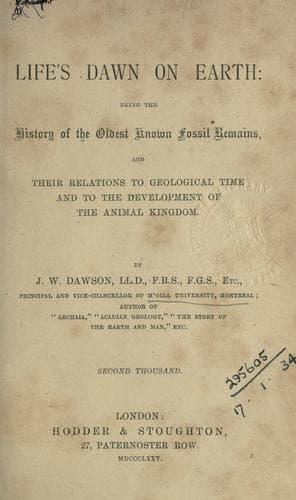
Life's Dawn on Earth: Being the history of the oldest known fossil remains, and their relations to geological time and to the development of the animal kingdomDawson, John William, Sir
History
Life's Dawn on Earth: Being the history of the oldest known fossil remains, and their relations to geological time and to the development of the animal kingdom
Dawson, John William, Sir
Life -- Origin; Paleontology -- Precambrian
infer that the foraminiferal sarcode, once introduced, might be the
substratum or foundation of other but unknown tissues in the higher
animals, and that the Protozoan type might continue to subsist side
by side with higher forms of living things as they were successively
introduced. He might also infer that the elevation of the animal
kingdom would take place with reference to those new properties of
sensation and voluntary motion in which the humblest animals diverge
from the life of the plant.
It is important that these points should be clearly before our minds,
because there has been current of late among naturalists a loose way
of writing with reference to them, which seems to have imposed on many
who are not naturalists. It has been said, for example, that such an
organism as Eozoon may include potentially all the structures and
functions of the higher animals, and that it is possible that we might
be able to infer or calculate all these with as much certainty as we
can calculate an eclipse or any other physical phenomenon. Now, there
is not only no foundation in fact for these assertions, but it is from
our present standpoint not conceivable that they can ever be realized.
The laws of inorganic matter give no data whence any _à priori_
deductions or calculations could be made as to the structure and
vital forces of the plant. The plant gives no data from which we can
calculate the functions of the animal. The Protozoon gives no data from
which we can calculate the specialties of the Mollusc, the Articulate,
or the Vertebrate. Nor unhappily do the present conditions of life of
themselves give us any sure grounds for predicting the new creations
that may be in store for our old planet. Those who think to build a
philosophy and even a religion on such data are mere dreamers, and have
no scientific basis for their dogmas. They are more blind guides than
our primæval Protozoon himself would be, in matters whose real solution
lies in the harmony of our own higher and immaterial nature with the
Being who is the author of all life--the Father "from whom every
family in heaven and earth is named."
While this work was going through the press, Lyell, the greatest
geological thinker of our time, passed away. In the preceding pages I
have refrained from quoting the many able geologists and biologists who
have publicly accepted the evidence of the animal nature of Eozoon as
sufficient, preferring to rest my case on its own merits rather than on
authority; but it is due to the great man whose loss we now mourn, to
say that, before the discovery of Eozoon, he had expressed on general
grounds his anticipation that fossils would be found in the rocks older
than the so-called Primordial Series, and that he at once admitted the
organic nature of Eozoon, and introduced it, as a fossil, into the
edition of his Elements of Geology published in the same year in which
it was described.
APPENDIX.
CHARACTERS OF LAURENTIAN AND HURONIAN PROTOZOA.
Public-domain text, read in full here on John Shaqi.
Reviews
Reviews
No reviews yet
Be the first to share your thoughts on this work.
Elsewhere in the archive
Join the Discussion
Join the discussion
Sign in to leave a comment or review.
Sign InorCreate an account