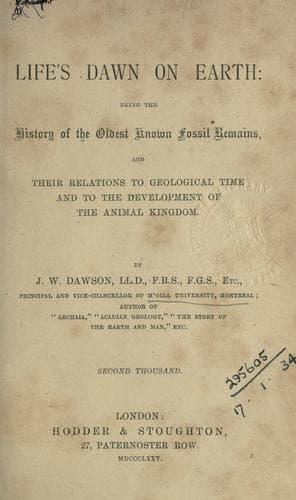
Life's Dawn on Earth: Being the history of the oldest known fossil remains, and their relations to geological time and to the development of the animal kingdomDawson, John William, Sir
History
Life's Dawn on Earth: Being the history of the oldest known fossil remains, and their relations to geological time and to the development of the animal kingdom
Dawson, John William, Sir
Life -- Origin; Paleontology -- Precambrian
It may be useful to students to state the technical characters of
Eozoon, in addition to the more popular and general descriptions in the
preceding pages.
_Genus_ EOZOON.
Foraminiferal skeletons, with irregular and often confluent cells,
arranged in concentric and horizontal laminæ, or sometimes piled in an
acervuline manner. Septal orifices irregularly disposed. Proper wall
finely tubulated. Intermediate skeleton with branching canals.
Eozoon Canadense, _Dawson_.
In rounded masses or thick encrusting sheets, frequently of large
dimensions. Typical structure stromatoporoid, or with concentric
calcareous walls, frequently uniting with each other, and separating
flat chambers, more or less mammillated, and spreading into horizontal
lobes and small chamberlets; chambers often confluent and crossed by
irregular calcareous pillars connecting the opposite walls. Upper
part often composed of acervuline chambers of rounded forms. Proper
wall tubulated very finely. Intermediate skeleton largely developed,
especially at the lower part, and traversed by large canals, often
with smaller canals in their interstices. Lower laminæ and chambers
often three millimetres in thickness. Upper laminæ and chambers one
millimetre or less. Age Laurentian and perhaps Huronian.
_Var._ MINOR.--Supplemental skeleton wanting, except near the base, and
with very fine canals. Laminæ of sarcode much mammillated, thin, and
separated by very thin walls. Probably a depauperated variety.
_Var._ ACERVULINA.--In oval or rounded masses, wholly acervuline. Cells
rounded; intermediate skeleton absent or much reduced; cell-walls
tubulated. This may be a distinct species, but it closely resembles the
acervuline parts of the ordinary form.
Eozoon Bavaricum, _Gümbel_.
Composed of small acervuline chambers, separated by contorted walls,
and associated with broad plate-like chambers below. Large canals
in the thicker parts of the intermediate skeleton. Differs from _E.
Canadense_ in its smaller and more contorted chambers. Age probably
Huronian.
_Genus_ ARCHÆOSPHERINA.
A provisional genus, to include rounded solitary chambers, or
globigerine assemblages of such chambers, with the cell-wall
surrounding them tubulated as in Eozoon. They may be distinct
organisms, or gemmæ or detached fragments of Eozoon. Some of them
much resemble the bodies figured by Dr. Carpenter, as gemmæ or ova
and primitive chambers of Orbitolites. They are very abundant on some
of the strata surfaces of the limestone at Côte St. Pierre. Age Lower
Laurentian.
SYSTEMATIC POSITION OF EOZOON.
Public-domain text, read in full here on John Shaqi.
Reviews
Reviews
No reviews yet
Be the first to share your thoughts on this work.
Elsewhere in the archive
Join the Discussion
Join the discussion
Sign in to leave a comment or review.
Sign InorCreate an account